
1
/
of
1
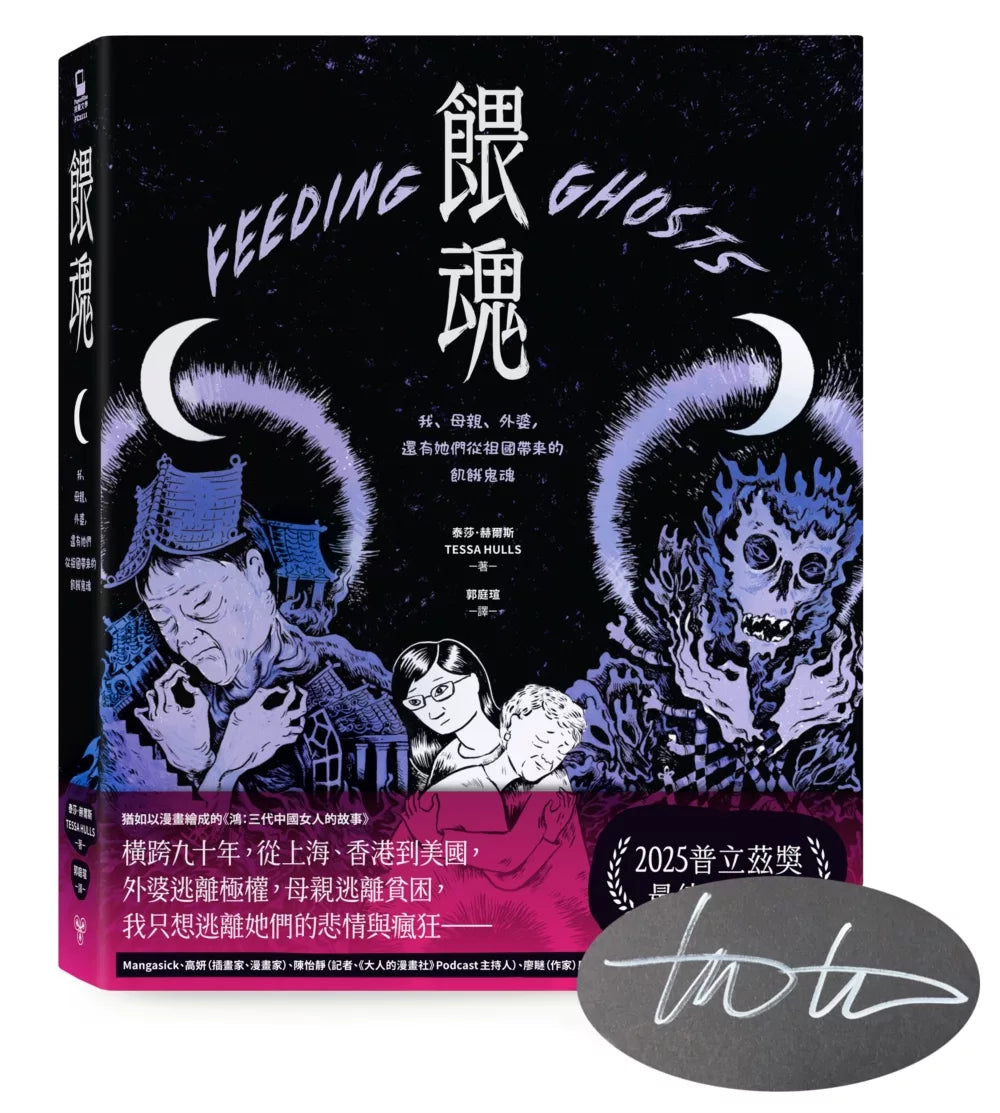
Feeding Ghosts: A Memoir (Pulitzer Prize Best Memoir, Signed by the Author)
Feeding Ghosts: A Memoir (Pulitzer Prize Best Memoir, Signed by the Author)
Tessa Hulls Guo Tingxuan 译
Regular price
$36.99 USD
Regular price
Sale price
$36.99 USD
Unit price
/
per
Low stock
Couldn't load pickup availability
ISBN
ISBN
9786263156975
share
书籍简介
Like a comic-drawn "Hóng: Three Generations of Chinese Women's Stories"
Spanning ninety years, from Shanghai, Hong Kong to the United States,
My grandmother escaped totalitarianism, my mother escaped poverty, and I just wanted to escape their tragedy and madness—
★2025 Pulitzer Prize for Best Memoir
★Eisner Award for Best Graphic Memoir, "Oscars of Comics"
★National Book Critics Circle Award for Best Debut Work
★Kirkus Reviews' Best Nonfiction Book of the Year
★Starred reviews from Publishers Weekly, Booklist, and Kirkus Reviews
Mangasick, Gao Yan (illustrator, cartoonist), Chen Yijing (journalist, host of "Adults' Comics Club" podcast), Liao Mi (writer)—heartfelt recommendations
"A moving work full of literary beauty and discovery, illustrating the life stories of three generations of Chinese women—the author, her mother, and her grandmother—bringing them to life on the page, and also presenting the traumatic experiences passed down through generations with their family history." —Pulitzer Prize Committee citation
┤Synopsis├
This is a true story of modern Chinese women in turbulent displacement, featuring three generations of women from author Teassa Hiels' family: her Chinese grandmother Sun Yi, her mother Rose, and herself.
Sun Yi was a Shanghai newspaper reporter and a new woman of the 1940s. The Communist Party's rise to power led to her being deprived of work opportunities due to her background. After becoming pregnant with her Swiss diplomat boyfriend's child, she was cruelly abandoned. After eight years of surveillance, interrogation, and house arrest, she smuggled herself and her daughter to Hong Kong. Upon arrival, Sun Yi wrote a book, "Eight Years in Red Shanghai," about her experiences surviving under the oppression of the CCP government. She used the royalties to send her daughter Rose to the best boarding school. However, just as her new life was about to begin, her mental health deteriorated, and she was eventually admitted to Hong Kong's first mental hospital, Castle Peak Hospital.
After her mother was hospitalized, Rose was taken in by a church school and received an upper-middle-class English education, but she was very lonely inside. After graduating from middle school, she went to the United States to study abroad and eventually brought Sun Yi to the United States to care for her. Sun Yi had no social network or language skills in the small American town where her daughter lived, and the two formed a close symbiotic relationship. Rose took on the heavy burden of supporting the family and caring for her mother. To soothe Sun Yi's mind, she created fictional publishing contracts and fake books to make her believe she was living a writer's life in her imagination.
Teassa witnessed her mother's sacrifices to care for Sun Yi. Sun Yi's trauma and mental illness were like hungry ghosts in Chinese custom, requiring constant attention and coaxing to feed, and they overshadowed the entire family, making Rose and Teassa's mother-daughter relationship consistently painful and strained.
To escape the omnipresent mental pressure at home, adult Teassa lived in distant corners of the world, even traveling to Antarctica to live in a research station. But when she turned thirty, this lifestyle no longer felt like freedom, but more like avoidance. So she decided to go home and face the unfamiliar history that made their three generations who they are today...
┤Heartfelt Reviews├
The four words that naturally came to mind while reading were "spiritual pollution." Although Hiels' narrative does not have the fragmented subjectivity and mania presented in "Neon Genesis Evangelion"'s visual language, it is closer to the hardened poetry of cooled lava. However, these daughters all call out to their mothers in different voices. Coincidentally, I just searched for "spiritual pollution" and discovered that the People's Republic of China had a brief political campaign in 1983 called "Clearing Spiritual Pollution." One day, the People's Daily mentioned "spiritual pollution" so frequently that they ran out of lead type—this also fits the impression Hiels' work gives; I have never seen anyone so meticulously document the spiritual pollution within a Han Chinese nation and family in one book. Read slowly, do not overdose at once.
──Mangasick
It sounds familiar, yet it feels as if I've never heard it before.
I seem to know, yet I don't truly understand.
Seemingly the same, yet so utterly different.
Teassa Hiels, with meticulous strokes, depicts a barrier as hard as wire, difficult to cross;
Yet, upon careful reading, one can feel the gentle current of tenderness and truth flowing between the "painted words."
Because love runs deep, so does the pain—people often weave bottomless pits in the name of love.
On the long train, she explores her roots through dialogue and understanding, while also chronicling the history and tragedy of an entire generation.
──Gao Yan (illustrator, cartoonist)
This is a story of two mothers and one daughter, and also a story of one mother and two daughters. It is very heavy, and also very moving. Where do those traumas, like ghosts, residing within them, come from? In the sharply contrasting black and white lines, sometimes concrete, sometimes abstract, sometimes breaking through the page, are embedded fragments of those memories.
The author Teassa Hiels' brushstrokes are detailed yet rough, like an unstoppable, bursting murmur in the mind. I can't help but think that her 10 years of research and creation, rediscovering her mother, and her mother's mother, might also be like a debridement surgery. Only by scraping open the wound and directly confronting the decaying flesh can the wound heal, even if it leaves a scar. As she wrote at the end: "Mother and daughter, both wounded and both saved by our imperfect love."
──Chen Yijing (journalist, host of "Adults' Comics Club" podcast)
出版日期/Publication Date:
出版社/Publisher:臉譜
出品方/Imprint:
页数/Page: 400