
1
/
of
1
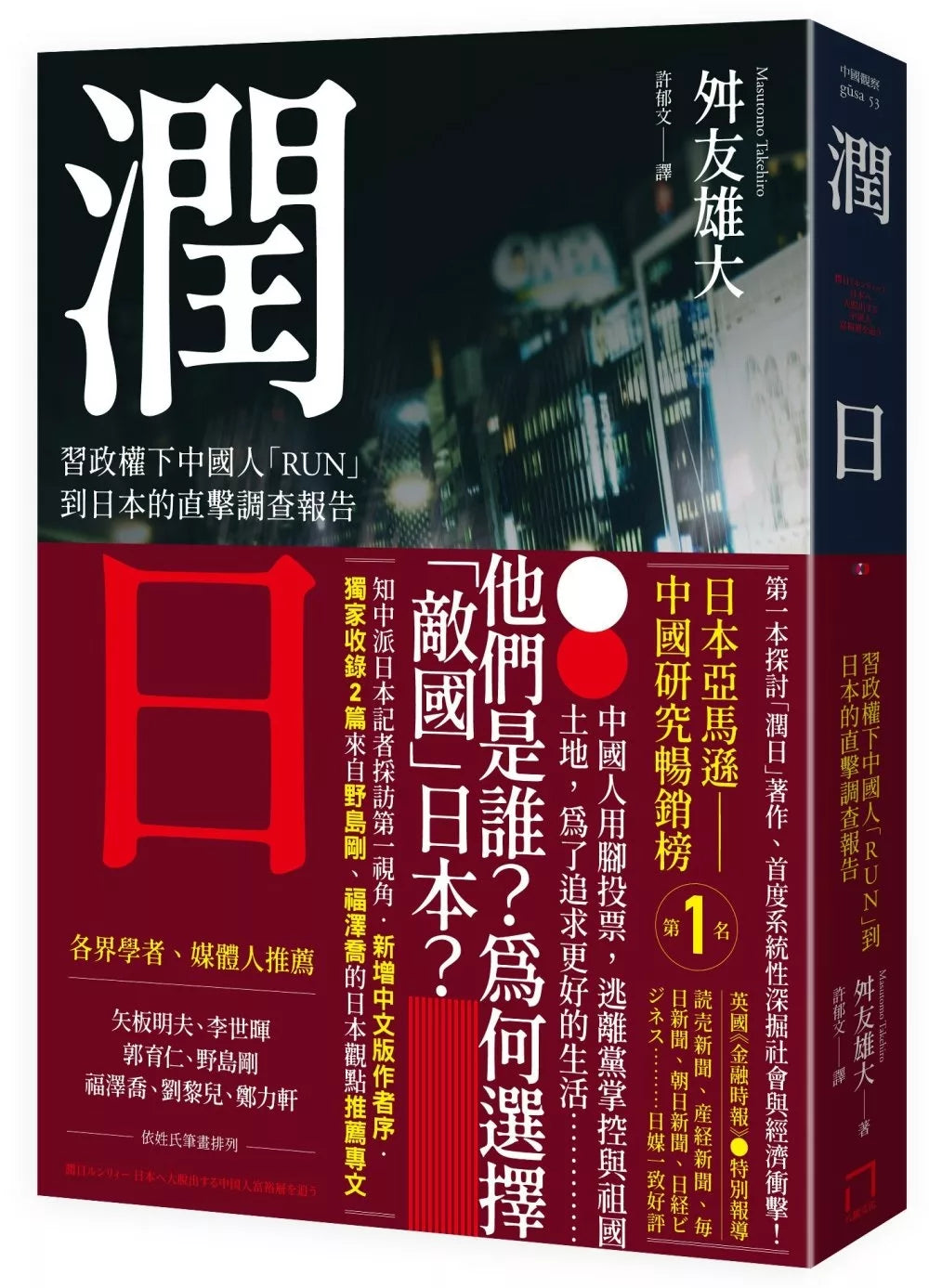
Run to Japan: An Eyewitness Investigative Report on Chinese People "RUNNING" Under the Xi Jinping Regime
Run to Japan: An Eyewitness Investigative Report on Chinese People "RUNNING" Under the Xi Jinping Regime
Masutomo Yuta Yuwen Xu 译
Regular price
$30.99 USD
Regular price
Sale price
$30.99 USD
Unit price
/
per
Out of stock
Couldn't load pickup availability
ISBN
ISBN
9786267509845
share
书籍简介
Keywords trending online in the Xi Jinping era
Did you "run" today?
The first true account of Chinese fleeing China to "run to Japan" The first systematic and in-depth exploration of social and economic impacts!
From the perspective of Chinese people "voting with their feet" A firsthand investigative report by a Japan-savvy, middle-generation Japanese journalist on "de-Sinicized" individuals in Japan.
Special Inclusion +1 | Exclusive Chinese preface by the author for the Taiwan edition Special Inclusion +2 | Joint 추천(recommendation) prefaces by Nojima Tsuyoshi and Fukuzawa Kyo Special Inclusion +3 | Essential for understanding contemporary China! 35 slang terms dictionary
● Japan and China have an irreconcilable history, with 300,000 compatriots killed in Nanjing. Why do Chinese people still go to the "enemy country"? ○ Minato Ward, Bunkyo Ward... targeting high-end areas and tourist spots. Is it "buying Japan" rather than "visiting Japan"? ● How do this new wave of "run-to-Japan" immigrants differ from the original "Chinese-origin" new overseas Chinese? ○ Why do Chinese intellectuals with "political depression" decide to "run" from China? ● Is the hidden network of Chinese communities gradually changing the future of Japanese society? ○ Is it possible for Japan to cultivate another "Sun Yat-sen" who will overthrow the old China?
What is "runology"? A new term on Chinese social media
Among the popular internet slang terms used by Chinese netizens, "run" refers to the act of choosing to leave China for various reasons in pursuit of a better life. In Chinese semantics, "run" originally means profit, or "zhīrùn" (滋潤), meaning comfortable and moisturized. In Chinese Pinyin, it happens to be spelled r-u-n, forming a pun with the English word "run" (to flee). In recent years, China has experienced turbulence due to the COVID-19 lockdowns, economic downturn, and unstable global economic situation. In this "garbage time of history," more and more people are choosing to "run" from China, leading to the emergence of "runology" and "The Program of Runology," which disseminates "runology" ideas and practical guides.
"Run to Japan" provokes the sensitive nerves of love-hate entanglement between China and Japan
The author's journey to investigate "running to Japan" began with the insane online bullying triggered by the death of Akid (Wang Yi), a "run-to-Japan" individual and a friend of the author, in Japan. After her death in 2023, her social media X (formerly Twitter) account was subjected to massive "crusades" by Chinese netizens, who sarcastically gloated, "Good riddance to the traitor who ran to Japan." This strong, distorted nationalism reignited the author's curiosity about Chinese society and a strong desire to understand the "run-to-Japan" population.
When Chinese people are "involution-ed" to the point of being unable to "roll" and unwilling to "lie flat," yet are also unwilling to be "leeks" to be exploited, why do these people, eager to "run" overseas, choose "enemy country" Japan? And how do people inside and outside the "wall" view "running to Japan"? These are the questions the author attempts to answer in the book.
The Multiverse of "Running to Japan"
Those who "run to Japan" include not only international professionals and super-rich individuals, but also exiled intellectuals, artists, cultural workers, and dissident media. There are also a considerable number of upper-middle-class individuals who refuse to let their next generation be subjected to China's high-pressure education system or who simply hope for a peaceful life. Through extensive interviews, on-site investigations, and reported data, the author attempts to delineate the differences between the "run-to-Japan group" and the "overseas Chinese in Japan" of the past, to explore their common characteristics and heterogeneous diversity, and to understand their real lives in Japan.
Whether the Japanese people and society like it or not, they must accept this reality that has become commonplace. They must directly confront the interpersonal friction and conflicts caused by a large number of different values and lifestyles, or perhaps even develop opportunities for positive interaction. The author states frankly in the book that during this series of interviews, despite getting to know some like-minded Chinese friends, it is possible that the desire was more to maintain a relationship limited to interviews and reports. Some people, in fact, the author did not wish to get close to or agree with. Nevertheless, this book is an important starting point and attempt. The first step is to understand the voices and life stories of these living "run-to-Japan individuals" before deciding how to deal with, interact with, and face the next steps together.
※Selected Recommendation Excerpts──
"Authentic Voices Emerge – Unique Observations on China!"
This book collects countless vivid interviews and testimonies, assembling them into a unique discourse on China and a study of Chinese people. From political pressure, the reality of a competitive society, various values, to omnipresent interpersonal networks, the book is never dull. At the same time, it clearly shows the differences between this "new generation of overseas Chinese" and those who came to Japan in the past. The author is not only fluent in Chinese and English but also possesses astonishing courage. He dares to venture alone into illegal money lenders and even question famous internet celebrities directly. Full of passion, the author possesses both keen interview instincts and deep analytical abilities, making him an undoubtedly rare and excellent writer. — Ryo Sahashi (Professor, University of Tokyo, author of "East Asian Order After the Cold War" and "US-China Rivalry"), Yomiuri Shimbun
"This book reveals the truth about Chinese people who come to Japan in pursuit of safety, prosperity, and happiness!"
In the past, the mainstream view among Chinese people was that their home country, China, was experiencing rapid economic development, so it was better to stay in China and make money, without the need to go to other countries and be a second-class citizen. However, since the 2000s, even though China slowly transitioned to a society governed by the rule of law, the COVID-19 pandemic demonstrated the strong power of the Chinese regime to fully control society, forcing countless Chinese people to confront the impact that their personal property and right to life might be incorporated into "state ownership." It is against this historical backdrop that the ideology of "run" began to spread. This book delicately describes how wealthy Chinese who fled to Japan live discreetly in a foreign land, and also records the lives of ordinary people who experience "small joys" in Japan. Because in China, even such small happiness can be taken away with one misstep.
These "runners" deeply feel the stagnation of the Chinese economy and the suffocation of society. Even those who have not yet left, those who can neither get rich nor gain freedom, are becoming the next wave of potential "runners." For them, Japan is a country that "still has freedom and opportunities for economic growth," and has even become a gathering place for Chinese intellectuals. — Yasushi Harada (Professor, Graduate School of Business and Finance, Nagoya University of Commerce & Business), "Economist Weekly" published by Mainichi Shimbun
"Depicting the true face of Chinese immigrants!"
The book also mentions many eye-catching details, including Chinese parents enrolling their children in prestigious cram schools, the gradual appearance of Chinese-style "clubs," and how they transfer money from China to Japan—topics in the "gray area." The content of the book will satisfy anyone curious about "what is happening in Japan today." — Megumi Nakajima (Freelance Journalist), Sankei Shimbun
Recommendations from all walks of life
※Jointly recommended by veteran media professionals, social commentators, and Japanese studies scholars──
Akio Yaita | Executive Director, Indo-Pacific Strategic Think Tank Li Shih-hui | Professor, Graduate Institute of East Asian Studies, National Chengchi University Kuo Yu-jen | Director, Graduate Institute of China and Asia-Pacific Studies, National Sun Yat-sen University Tsuyoshi Nojima | Writer / Senior Media Professional Joel Fukuzawa | Administrator of "Joel Talk Japan" Facebook Page / Media Professional Liu Li-er | Japan Observer Cheng Li-hsuan | Professor of Sociology, National Chengchi University (Listed in alphabetical order by surname)
※Media Acclaim──
* #1 Bestseller in Chinese Studies on Amazon Japan * Featured in the Financial Times * Unanimously praised by Japan's Yomiuri Shimbun, Sankei Shimbun, Mainichi Shimbun, Asahi Shimbun, Nikkei Business... * Finalist for the 47th Kodansha "Yasuharu Honda Non-fiction Award" * Reviewed in "East Asia" magazine's March issue and selected as "Book of the Month" * Special book review by Shinjo Kou, author of "Jimen-shi" (The Land Speculator), published in "Weekly Gendai"
The first true account of Chinese fleeing China to "run to Japan" The first systematic and in-depth exploration of social and economic impacts!
From the perspective of Chinese people "voting with their feet" A firsthand investigative report by a Japan-savvy, middle-generation Japanese journalist on "de-Sinicized" individuals in Japan.
Special Inclusion +1 | Exclusive Chinese preface by the author for the Taiwan edition Special Inclusion +2 | Joint 추천(recommendation) prefaces by Nojima Tsuyoshi and Fukuzawa Kyo Special Inclusion +3 | Essential for understanding contemporary China! 35 slang terms dictionary
● Japan and China have an irreconcilable history, with 300,000 compatriots killed in Nanjing. Why do Chinese people still go to the "enemy country"? ○ Minato Ward, Bunkyo Ward... targeting high-end areas and tourist spots. Is it "buying Japan" rather than "visiting Japan"? ● How do this new wave of "run-to-Japan" immigrants differ from the original "Chinese-origin" new overseas Chinese? ○ Why do Chinese intellectuals with "political depression" decide to "run" from China? ● Is the hidden network of Chinese communities gradually changing the future of Japanese society? ○ Is it possible for Japan to cultivate another "Sun Yat-sen" who will overthrow the old China?
What is "runology"? A new term on Chinese social media
Among the popular internet slang terms used by Chinese netizens, "run" refers to the act of choosing to leave China for various reasons in pursuit of a better life. In Chinese semantics, "run" originally means profit, or "zhīrùn" (滋潤), meaning comfortable and moisturized. In Chinese Pinyin, it happens to be spelled r-u-n, forming a pun with the English word "run" (to flee). In recent years, China has experienced turbulence due to the COVID-19 lockdowns, economic downturn, and unstable global economic situation. In this "garbage time of history," more and more people are choosing to "run" from China, leading to the emergence of "runology" and "The Program of Runology," which disseminates "runology" ideas and practical guides.
"Run to Japan" provokes the sensitive nerves of love-hate entanglement between China and Japan
The author's journey to investigate "running to Japan" began with the insane online bullying triggered by the death of Akid (Wang Yi), a "run-to-Japan" individual and a friend of the author, in Japan. After her death in 2023, her social media X (formerly Twitter) account was subjected to massive "crusades" by Chinese netizens, who sarcastically gloated, "Good riddance to the traitor who ran to Japan." This strong, distorted nationalism reignited the author's curiosity about Chinese society and a strong desire to understand the "run-to-Japan" population.
When Chinese people are "involution-ed" to the point of being unable to "roll" and unwilling to "lie flat," yet are also unwilling to be "leeks" to be exploited, why do these people, eager to "run" overseas, choose "enemy country" Japan? And how do people inside and outside the "wall" view "running to Japan"? These are the questions the author attempts to answer in the book.
The Multiverse of "Running to Japan"
Those who "run to Japan" include not only international professionals and super-rich individuals, but also exiled intellectuals, artists, cultural workers, and dissident media. There are also a considerable number of upper-middle-class individuals who refuse to let their next generation be subjected to China's high-pressure education system or who simply hope for a peaceful life. Through extensive interviews, on-site investigations, and reported data, the author attempts to delineate the differences between the "run-to-Japan group" and the "overseas Chinese in Japan" of the past, to explore their common characteristics and heterogeneous diversity, and to understand their real lives in Japan.
Whether the Japanese people and society like it or not, they must accept this reality that has become commonplace. They must directly confront the interpersonal friction and conflicts caused by a large number of different values and lifestyles, or perhaps even develop opportunities for positive interaction. The author states frankly in the book that during this series of interviews, despite getting to know some like-minded Chinese friends, it is possible that the desire was more to maintain a relationship limited to interviews and reports. Some people, in fact, the author did not wish to get close to or agree with. Nevertheless, this book is an important starting point and attempt. The first step is to understand the voices and life stories of these living "run-to-Japan individuals" before deciding how to deal with, interact with, and face the next steps together.
※Selected Recommendation Excerpts──
"Authentic Voices Emerge – Unique Observations on China!"
This book collects countless vivid interviews and testimonies, assembling them into a unique discourse on China and a study of Chinese people. From political pressure, the reality of a competitive society, various values, to omnipresent interpersonal networks, the book is never dull. At the same time, it clearly shows the differences between this "new generation of overseas Chinese" and those who came to Japan in the past. The author is not only fluent in Chinese and English but also possesses astonishing courage. He dares to venture alone into illegal money lenders and even question famous internet celebrities directly. Full of passion, the author possesses both keen interview instincts and deep analytical abilities, making him an undoubtedly rare and excellent writer. — Ryo Sahashi (Professor, University of Tokyo, author of "East Asian Order After the Cold War" and "US-China Rivalry"), Yomiuri Shimbun
"This book reveals the truth about Chinese people who come to Japan in pursuit of safety, prosperity, and happiness!"
In the past, the mainstream view among Chinese people was that their home country, China, was experiencing rapid economic development, so it was better to stay in China and make money, without the need to go to other countries and be a second-class citizen. However, since the 2000s, even though China slowly transitioned to a society governed by the rule of law, the COVID-19 pandemic demonstrated the strong power of the Chinese regime to fully control society, forcing countless Chinese people to confront the impact that their personal property and right to life might be incorporated into "state ownership." It is against this historical backdrop that the ideology of "run" began to spread. This book delicately describes how wealthy Chinese who fled to Japan live discreetly in a foreign land, and also records the lives of ordinary people who experience "small joys" in Japan. Because in China, even such small happiness can be taken away with one misstep.
These "runners" deeply feel the stagnation of the Chinese economy and the suffocation of society. Even those who have not yet left, those who can neither get rich nor gain freedom, are becoming the next wave of potential "runners." For them, Japan is a country that "still has freedom and opportunities for economic growth," and has even become a gathering place for Chinese intellectuals. — Yasushi Harada (Professor, Graduate School of Business and Finance, Nagoya University of Commerce & Business), "Economist Weekly" published by Mainichi Shimbun
"Depicting the true face of Chinese immigrants!"
The book also mentions many eye-catching details, including Chinese parents enrolling their children in prestigious cram schools, the gradual appearance of Chinese-style "clubs," and how they transfer money from China to Japan—topics in the "gray area." The content of the book will satisfy anyone curious about "what is happening in Japan today." — Megumi Nakajima (Freelance Journalist), Sankei Shimbun
Recommendations from all walks of life
※Jointly recommended by veteran media professionals, social commentators, and Japanese studies scholars──
Akio Yaita | Executive Director, Indo-Pacific Strategic Think Tank Li Shih-hui | Professor, Graduate Institute of East Asian Studies, National Chengchi University Kuo Yu-jen | Director, Graduate Institute of China and Asia-Pacific Studies, National Sun Yat-sen University Tsuyoshi Nojima | Writer / Senior Media Professional Joel Fukuzawa | Administrator of "Joel Talk Japan" Facebook Page / Media Professional Liu Li-er | Japan Observer Cheng Li-hsuan | Professor of Sociology, National Chengchi University (Listed in alphabetical order by surname)
※Media Acclaim──
* #1 Bestseller in Chinese Studies on Amazon Japan * Featured in the Financial Times * Unanimously praised by Japan's Yomiuri Shimbun, Sankei Shimbun, Mainichi Shimbun, Asahi Shimbun, Nikkei Business... * Finalist for the 47th Kodansha "Yasuharu Honda Non-fiction Award" * Reviewed in "East Asia" magazine's March issue and selected as "Book of the Month" * Special book review by Shinjo Kou, author of "Jimen-shi" (The Land Speculator), published in "Weekly Gendai"
出版日期/Publication Date:
出版社/Publisher:八旗文化
出品方/Imprint:
页数/Page: 352