
1
/
of
1
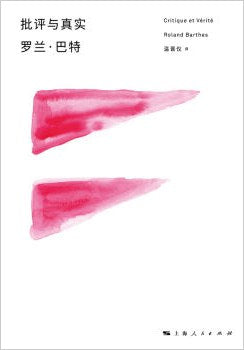
Criticism and Truth
Criticism and Truth
[French] Roland Barthes Wen Jinyi 译
Regular price
$9.99 USD
Regular price
$8.99 USD
Sale price
$9.99 USD
Unit price
/
per
Low stock
Couldn't load pickup availability
ISBN
ISBN
9787208139077
share
书籍简介
In the early 1960s, Barthes studied semiotics and structuralism at the Ecole des Hautes Études en Sciences Sociales. He discussed traditional academic literary theory and the forms of popular literature. His unique perspective, known as New Criticism, drew the ire of other thinkers, who believed he ignored and disrespected the cultural roots of literature. Barthes then published Criticism and the Real.
Criticism and the Real can be seen as Roland Barthes's manifesto for the New Criticism movement. The book is divided into two parts: the first fiercely refutes the arguments and evidence of his polemical opponent, the French literary critic Raymond Picard; the second proposes a literary science, namely that literary criticism should be an open-ended, risky discourse that assigns a particular meaning to a work, imposing a meaning rather than analyzing how it is produced. In this polemic, Roland Barthes pushes his opponents toward a right-wing, even extreme-right, position, while he himself stands in opposition, joining a camp that began with Proust and continued through Freud, Lacan, Chomsky, Mallarmé, Jakobson, Blanchot, and continues with Bataille, Saussure, Lévi-Strauss, Lukács, and Goldman. In this camp, there are no more poets or novelists, only writing itself.
Criticism and the Real can be seen as Roland Barthes's manifesto for the New Criticism movement. The book is divided into two parts: the first fiercely refutes the arguments and evidence of his polemical opponent, the French literary critic Raymond Picard; the second proposes a literary science, namely that literary criticism should be an open-ended, risky discourse that assigns a particular meaning to a work, imposing a meaning rather than analyzing how it is produced. In this polemic, Roland Barthes pushes his opponents toward a right-wing, even extreme-right, position, while he himself stands in opposition, joining a camp that began with Proust and continued through Freud, Lacan, Chomsky, Mallarmé, Jakobson, Blanchot, and continues with Bataille, Saussure, Lévi-Strauss, Lukács, and Goldman. In this camp, there are no more poets or novelists, only writing itself.
出版日期/Publication Date:
出版社/Publisher:上海人民出版社
出品方/Imprint:
页数/Page: 58