
1
/
of
1
Thousand Paper Cranes
Thousand Paper Cranes
[JP] Yasunari Kawabata Chen Dewen 译
Regular price
$25.99 USD
Regular price
Sale price
$25.99 USD
Unit price
/
per
Out of stock
Couldn't load pickup availability
ISBN
ISBN
9787559857606
share
书籍简介
★ Kawabata's Nobel Prize-winning work, a sensual feast of forbidden and pure love!
To truly understand the aesthetics of Japanese tea ceremony and ceramics, one must read "Thousand Cranes"!
—Includes the complete ending! Making up for the regret of only knowing "Thousand Cranes" but not its sequel, "The Wild Geese"!
"Thousand Cranes" constructs a surreal sensory world with traditional Japanese tea ceremony and classical tea bowls, fully depicting the subtle beauty of men and women's desires in Japan. The immoral yet pure love also became a paradigm of modern Japanese tragic romance, influencing many subsequent world literary giants.
Kawabata also conquered the Western literary world with the "lingering charm" of Eastern love in "Thousand Cranes."
It also includes "The Wild Geese," Kawabata's official sequel published by Shinchosha, sweeping away the regret of unpredictable endings in Japanese literature and offering a glimpse into the delicate melancholy of the body becoming eternal!
I harbor suspicion and vigilance towards the vulgar tea ceremony prevalent in the world today. Please do not completely interpret "Thousand Cranes" as the embodiment of the spirit and aesthetic form of the Japanese tea ceremony. —Yasunari Kawabata, Nobel Prize Acceptance Speech
★ A new, meticulously translated edition by Chen Dewen, translator of "Page, Mishima Bunko" and a giant in Japanese literary translation!
—A heartfelt postscript from his visit to Snow Country, deeply revealing the historical background of Kawabata's literature, helping you better understand Kawabata and Japan!
Renowned scholar Chen Dewen, who has delved into Japanese literature for decades, provides exquisite translations and meticulous校对. His translations are elegant, fluent, profound, and refined, seamlessly merging with Kawabata's original work; allowing readers of every generation to explore the realm of tea ceremony and appreciate the elegance of tea bowls from different perspectives and mindsets, breaking physical taboos in a subtly beautiful aesthetic world and exploring the charm of Nobel Prize-winning classic tragic romance.
I have always loved reading Kawabata's and Mishima's literature, delving deep, hoping to gain something. —Translator Chen Dewen
★ Shiohe, designer of Page Bunko, premieres Kawabata's new concept "Lyricism of Snow," once again leading the aesthetics of bunko editions!
—Pure white series, dedicated to spring snow, dedicated to sorrow and beauty, and dedicated to you
Ingenious design, a cherished item, heralding the bunko edition!
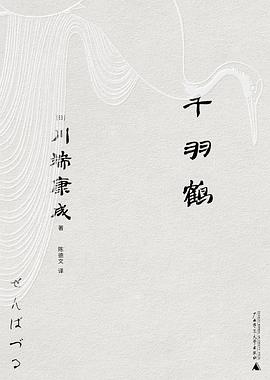
The overall visual design of Kawabata Bunko is orchestrated by designer Shiohe, with "Lyricism of Snow" as its theme. The dust jacket uses special paper with a mother-of-pearl lacquer chip hot stamping technique, presenting multiple textures of white under different lighting; the inner cover uses medieval sacred text border patterns; the endpapers are all exquisite illustrations from ancient Japanese books corresponding to the dust jacket, further representing the aesthetic intention of each book.
【Synopsis】
"The purest things are never defiled by anything."
Kikuji initially felt a moral revulsion towards his father's mistress for leaving behind a half-sibling, yet he later fell in love with both his deceased father's mistress, Mrs. Ota, and his half-sister, Fumiko. He had relations with Mrs. Ota, who, unable to bear the illicit love, chose to end her life.
Chikako, a former tea ceremony teacher who knew everything, threads through the entire story, introducing Kikuji to Yukiko, a woman of impeccable background. Although Kikuji saw Yukiko as his ideal woman, after marrying her, he resented Chikako's disguised surveillance and was unable to express his love for Yukiko. It was not until the letter from Fumiko, who had also left due to feelings of immorality and was untraceable, was burned by Kikuji that he was finally able to confront the entanglement of love, death, and sin involving himself and the four women.
"Thousand Cranes" is one of Yasunari Kawabata's Nobel Prize-winning works, a paradigm of modern Japanese illicit and tragic romance, influencing many subsequent world literary giants.
To truly understand the aesthetics of Japanese tea ceremony and ceramics, one must read "Thousand Cranes"!
—Includes the complete ending! Making up for the regret of only knowing "Thousand Cranes" but not its sequel, "The Wild Geese"!
"Thousand Cranes" constructs a surreal sensory world with traditional Japanese tea ceremony and classical tea bowls, fully depicting the subtle beauty of men and women's desires in Japan. The immoral yet pure love also became a paradigm of modern Japanese tragic romance, influencing many subsequent world literary giants.
Kawabata also conquered the Western literary world with the "lingering charm" of Eastern love in "Thousand Cranes."
It also includes "The Wild Geese," Kawabata's official sequel published by Shinchosha, sweeping away the regret of unpredictable endings in Japanese literature and offering a glimpse into the delicate melancholy of the body becoming eternal!
I harbor suspicion and vigilance towards the vulgar tea ceremony prevalent in the world today. Please do not completely interpret "Thousand Cranes" as the embodiment of the spirit and aesthetic form of the Japanese tea ceremony. —Yasunari Kawabata, Nobel Prize Acceptance Speech
★ A new, meticulously translated edition by Chen Dewen, translator of "Page, Mishima Bunko" and a giant in Japanese literary translation!
—A heartfelt postscript from his visit to Snow Country, deeply revealing the historical background of Kawabata's literature, helping you better understand Kawabata and Japan!
Renowned scholar Chen Dewen, who has delved into Japanese literature for decades, provides exquisite translations and meticulous校对. His translations are elegant, fluent, profound, and refined, seamlessly merging with Kawabata's original work; allowing readers of every generation to explore the realm of tea ceremony and appreciate the elegance of tea bowls from different perspectives and mindsets, breaking physical taboos in a subtly beautiful aesthetic world and exploring the charm of Nobel Prize-winning classic tragic romance.
I have always loved reading Kawabata's and Mishima's literature, delving deep, hoping to gain something. —Translator Chen Dewen
★ Shiohe, designer of Page Bunko, premieres Kawabata's new concept "Lyricism of Snow," once again leading the aesthetics of bunko editions!
—Pure white series, dedicated to spring snow, dedicated to sorrow and beauty, and dedicated to you
Ingenious design, a cherished item, heralding the bunko edition!
The overall visual design of Kawabata Bunko is orchestrated by designer Shiohe, with "Lyricism of Snow" as its theme. The dust jacket uses special paper with a mother-of-pearl lacquer chip hot stamping technique, presenting multiple textures of white under different lighting; the inner cover uses medieval sacred text border patterns; the endpapers are all exquisite illustrations from ancient Japanese books corresponding to the dust jacket, further representing the aesthetic intention of each book.
【Synopsis】
"The purest things are never defiled by anything."
Kikuji initially felt a moral revulsion towards his father's mistress for leaving behind a half-sibling, yet he later fell in love with both his deceased father's mistress, Mrs. Ota, and his half-sister, Fumiko. He had relations with Mrs. Ota, who, unable to bear the illicit love, chose to end her life.
Chikako, a former tea ceremony teacher who knew everything, threads through the entire story, introducing Kikuji to Yukiko, a woman of impeccable background. Although Kikuji saw Yukiko as his ideal woman, after marrying her, he resented Chikako's disguised surveillance and was unable to express his love for Yukiko. It was not until the letter from Fumiko, who had also left due to feelings of immorality and was untraceable, was burned by Kikuji that he was finally able to confront the entanglement of love, death, and sin involving himself and the four women.
"Thousand Cranes" is one of Yasunari Kawabata's Nobel Prize-winning works, a paradigm of modern Japanese illicit and tragic romance, influencing many subsequent world literary giants.
出版日期/Publication Date:
出版社/Publisher:广西师范大学出版社
出品方/Imprint:One folio
页数/Page: 304