
1
/
of
1
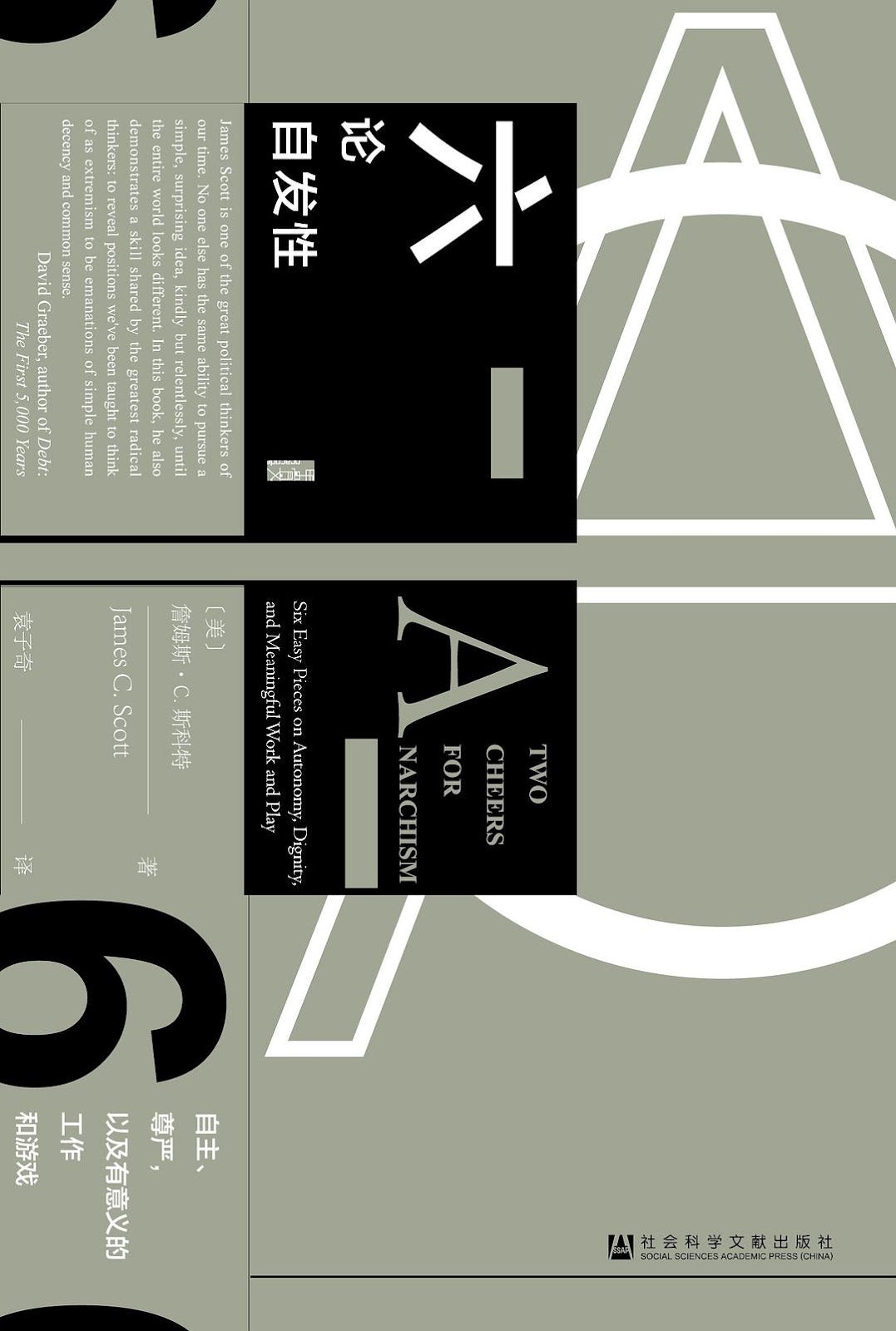
Six Essays on Spontaneity
Six Essays on Spontaneity
Autonomy, dignity, and meaningful work and play
James C. Scott Yuan Ziqi 译Regular price
$17.99 USD
Regular price
$17.99 USD
Sale price
$17.99 USD
Unit price
/
per
Low stock
Couldn't load pickup availability
ISBN
ISBN
9787520142625
share
书籍简介
【Content Introduction】
James Scott, a renowned contemporary thinker and Yale professor, has shown us why the national perspective is wrong. Now, in this concise, accessible, and deeply personal new book, he demonstrates why the anarchist perspective matters. Engaging, combative, and even humorous, he defends anarchist thinking that values local knowledge, common sense, individual creativity, and spontaneity, allowing us to examine the world in all its dimensions—from everyday sociopolitical interactions in schools, factories, nursing homes, and playgrounds to the scale of popular protest and revolution.
【Editor's Recommendation】
The anarchism in this book isn't an ideology or a political stance, but rather a critical mode of thinking that can be applied to a wide range of everyday phenomena, such as the placement of traffic lights, shortcuts, place names, forest or plantation management, amusement park design, the significance of scientific literature indexing systems, and the relationship between nursing homes and the elderly. By applying an anarchist, non-state perspective, Scott explores the paradoxes inherent in these phenomena. For example, Ford's plantation illustrates how some procedures designed for efficiency can actually lead to a lack of efficiency, while the seemingly chaotic arrangement of local Guatemalan orchards reveals a more scientific logic. In short, as a collection of essays on spontaneity written by a leading social scientist, this booklet, a collection of reflections on the small details of life, helps readers cultivate critical and dialectical thinking.
James Scott, a renowned contemporary thinker and Yale professor, has shown us why the national perspective is wrong. Now, in this concise, accessible, and deeply personal new book, he demonstrates why the anarchist perspective matters. Engaging, combative, and even humorous, he defends anarchist thinking that values local knowledge, common sense, individual creativity, and spontaneity, allowing us to examine the world in all its dimensions—from everyday sociopolitical interactions in schools, factories, nursing homes, and playgrounds to the scale of popular protest and revolution.
【Editor's Recommendation】
The anarchism in this book isn't an ideology or a political stance, but rather a critical mode of thinking that can be applied to a wide range of everyday phenomena, such as the placement of traffic lights, shortcuts, place names, forest or plantation management, amusement park design, the significance of scientific literature indexing systems, and the relationship between nursing homes and the elderly. By applying an anarchist, non-state perspective, Scott explores the paradoxes inherent in these phenomena. For example, Ford's plantation illustrates how some procedures designed for efficiency can actually lead to a lack of efficiency, while the seemingly chaotic arrangement of local Guatemalan orchards reveals a more scientific logic. In short, as a collection of essays on spontaneity written by a leading social scientist, this booklet, a collection of reflections on the small details of life, helps readers cultivate critical and dialectical thinking.
出版日期/Publication Date:
出版社/Publisher:社会科学文献出版社
出品方/Imprint:Oracle
页数/Page: 230