
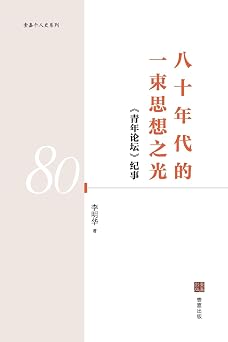
A Ray of Ideological Light from the 1980s: A Chronicle of Youth Forum
A Ray of Ideological Light from the 1980s: A Chronicle of Youth Forum
Li Minghua
Low stock
Couldn't load pickup availability
ISBN
ISBN
share
书籍简介
Published by Yi Jia Publishing
This is the best book I have read so far on the intellectual history of China in the 1980s. --Hu Ping, renowned scholar and honorary editor-in-chief of "Beijing Spring"
This book not only records the history of "Youth Forum" and has historical significance, but also provides a foundation and starting point for the re-launching of an enlightenment movement in the future. --Xu Youyu, researcher at the Institute of Philosophy, Chinese Academy of Social Sciences, and renowned scholar
The "personal experiences, little-known, and unrecorded details that flow from the pen" in this book are extremely valuable. Li Minghua eventually opened up his writing to reflect on the blind spots and limitations of the past, discussed historical lessons, and looked ahead to the changes in the current intellectual market. In these aspects, he surpassed the editors-in-chief of other famous publications. He fulfilled the responsibility that a historical participant should. --Ding Dong, renowned scholar
Among the 14 issues, 8 were on the theme of "freedom," almost throughout the entire publication process. Such intensive and thorough discussions were rare among unofficial publications of the same period. "Youth Forum" stood out in the 1980s by upholding the spirit of "freedom," which undoubtedly has significance and value for intellectual history and publishing history. --Qian Liqun, renowned scholar and professor at Peking University
This publication indeed published many insightful and courageous articles that were difficult to find elsewhere. It proposed or initially demonstrated many sharp and sensitive theoretical and practical issues, which scholars and venerable elders dared not easily write about. Although these articles were immature and flawed, they clearly showed the theoretical sharpness and vigor of the younger generation's strong pursuit of reform. --Li Zehou, renowned scholar
The 1980s was a magnificent era in China's intellectual history. Intellectuals and the general public broke free from ideological shackles, and the calls for freedom, democracy, rule of law, and humanism were unprecedentedly strong.
In the intellectual emancipation movement of this period, theoretical journals played a leading role. "Youth Forum" magazine was one of the pioneers, founded in 1984 by a group of young scholars from the Hubei Academy of Social Sciences. It sparked a sensation in theoretical circles with its intellectual sharp edge that dared to touch on sensitive political issues and its fresh, lively, and straightforward writing style. It was known as "one newspaper, one magazine" along with Shanghai's "World Economic Herald."
As the political situation fluctuated, "Youth Forum," which had close ties to Hu Deping, son of then-General Secretary of the CPC Central Committee Hu Yaobang, also rose and fell, enduring the turbulent waves of political turmoil. Ultimately, the fiercely burning intellectual flame was extinguished. "Youth Forum" spanned four years in total, publishing fourteen issues.
"A Ray of Intellectual Light in the Eighties: A Chronicle" is the memoir of Li Minghua, former editor-in-chief of "Youth Forum" magazine. He wrote this chronicle based on his personal experiences and records, combined with the recollections of many colleagues, authors, and relevant individuals from that time. In the book, he outlines the macroscopic stage of China's intellectual world in the 1980s, sorts out the development脈絡 (main thread) of Chinese intellectual trends in the 1980s, and conducts in-depth analysis and theoretical reflections. Against this background, he uses a large amount of detailed first-hand information to meticulously document the founding, development, rectification, and eventual closure of "Youth Forum." He leads readers to revisit the sharp intellectual edge of Chinese youth in the 1980s, their passionate and unadorned idealistic fervor, and their courage and responsibility to care about and change reality. Readers can feel the support of intellectual and cultural elites such as Li Zehou, Wang Ruoshui, Li Rui, Liu Binyan, and Dai Qing for "Youth Forum." What is even more rare is that it also records the complex mentality and performance of officials at all levels, from the central government to local governments, towards "Youth Forum," which is extremely helpful for understanding the officialdom ecology of China in the 1980s and its interaction with social and cultural trends.
The historical details disclosed and recorded in this book have important value for intellectual history.
出版日期/Publication Date:
出版社/Publisher:1 Plus Books
出品方/Imprint:
页数/Page: 598