
1
/
of
1
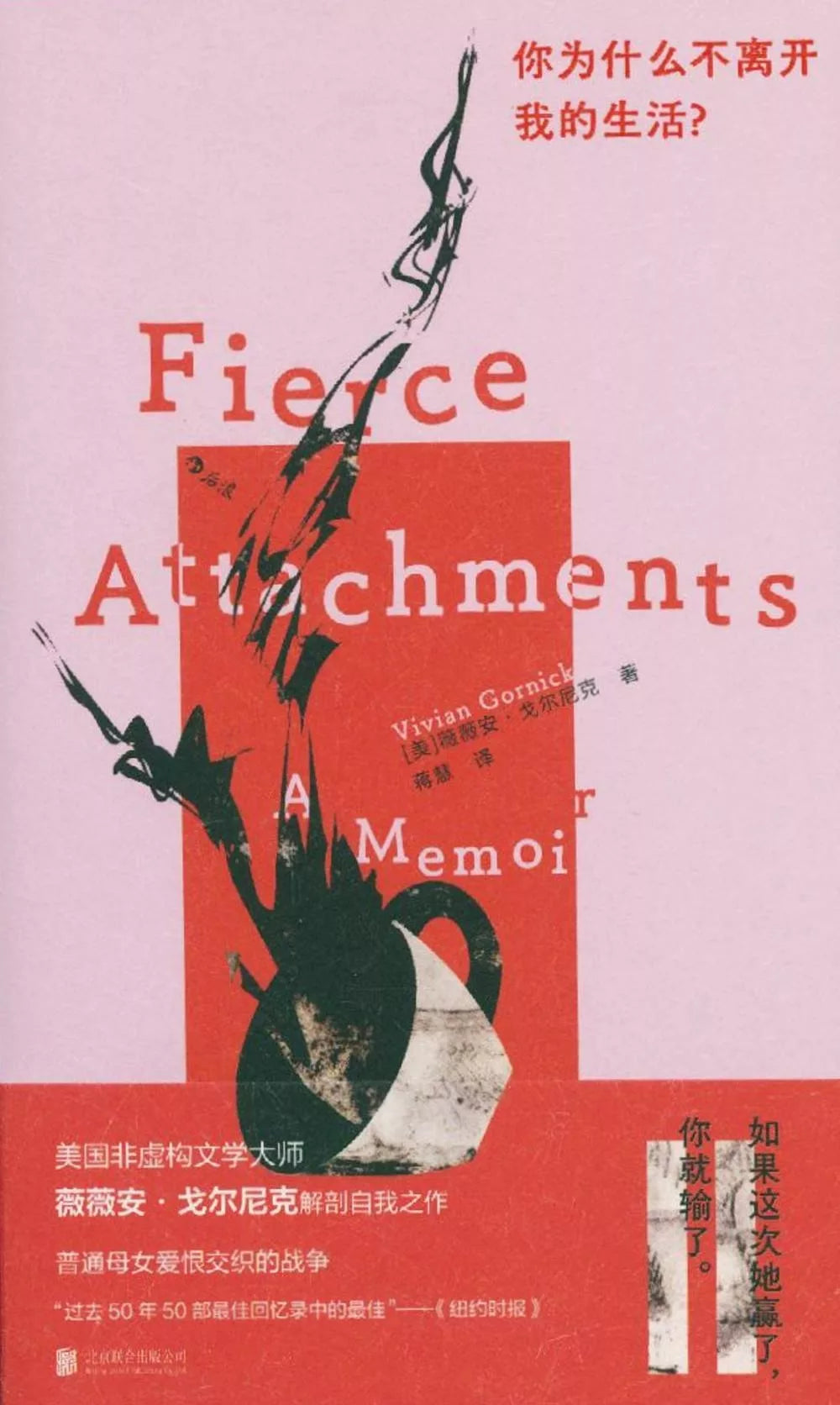
Why don't you get out of my life?
Why don't you get out of my life?
[US] Vivian Gornick Jiang Hui 译
Regular price
$16.99 USD
Regular price
Sale price
$16.99 USD
Unit price
/
per
Low stock
Couldn't load pickup availability
ISBN
ISBN
9787559677655
share
书籍简介
📚
“WoMen” Book Series:
Through us, see the world.
The first Chinese translation of Vivian Gornick's work, master of American nonfiction literature.
"Why aren't you leaving yet? Why don't you leave my life?"
The intertwined love and hate war of ordinary mothers and daughters
"Two women with similar limitations, intimately connected,
simply because they have lived their entire lives in each other's orbit."
Gornick's writing, completed by delving deep into her own self.
No matter how embarrassing, she still tries to find the truth about herself.
🌊
Editor's Recommendation:
◎Vivian Gornick, a master of American nonfiction literature, honestly writes about the relationship between herself and her mother after entering middle age. She not only objectively and sharply examines her mother but also dissects herself, revealing her complex feelings towards her mother, herself, love, and the world without disguise.
★My relationship with my mother is not good; as I get older, it often seems to get worse.
★I desperately want to get away from her, but I can't leave the room she's in. I'm scared when she comes home from work, but I've never been absent the moment she returns.
★I want to share some of the light that bursts from my heart with her, to share some of the great joy in my life with her. Simply because she is the intimate companion I have known the longest.
My mother is good at spoiling fun and can't let go of interfering with her children. She doesn't know how to express herself, so she can only turn all negative emotions into self-pity and anger. She is used to using anger to cover up fear and shame. She is passionate and caustic, out of control and generous, sarcastic and critical, and sometimes, she even shows what she understands as deep affection: the rough and overbearing manner she displays when her heart is overflowing with the tenderness she fears most.
In the eyes of others, I am: a graduate student, a writer, a published author, married and divorced, childless, a "new woman, free woman, and strange woman." But in the mother-daughter relationship: I am always the ordinary daughter who failed to meet her mother's expectations.
The ordinary daughter cannot fulfill the mother's unchanging expectations, and the mother does not want to find her own shrouded self either. All along, I have tried every method to try and escape my mother's influence, to avoid becoming a copy of her. I once saw my mother as the opposite of self and freedom, but my mother is not the antonym of any concept.
🎈
◎I am my mother's daughter, but why do I want to distance myself from her? And how can I truly distance myself from her?
★And love, she said, was everything. A woman's life was entirely determined by love. She was terribly wrong, her view of love was absurd, and she was a slave to her own views on marriage.
★"Believe me, if it weren't for the fact that I loved your father." She would say plainly how unwilling she was to give up her job after getting married, how wonderful it felt to have money in her pocket and not have to ask for pocket money like a child, how foolish her current life was, and how much she wanted to go back to work. Believe her. If it weren't for dad's love.
★This was her situation: In this kitchen, she was self-aware; in this kitchen, she was irritable and bored; in this kitchen, she did housework impeccably; in this kitchen, she despised what she was doing. She was annoyed by what she called the "emptiness of women's lives" and then burst out laughing while analyzing the complex situation in the alley—a laugh I still remember to this day. Negative in the morning, rebellious in the afternoon, she was created and destroyed daily. She ravenously grabbed the only thing she could get and gradually fell in love with her own vitality, and then she felt like a traitor.
★"Remember," she said, "you are my daughter. Be strong. You must be strong."
"Oh, Mom!" I cried, my fearful, greedy, freedom-loving life welling up in my heart, spilling from my soft face, and that face, she gave to me.
In this book, Gornick writes about the details of her relationship with her mother with a frank, delicate, humorous, and vivid pen, recalling old acquaintances and past events during walks with her mother.
As a child, I absorbed new experiences from women very different from my mother. In college, I pursued ideas and understood myself. Several romantic relationships and marriages also became my refuge. I used work to counter the hurt I experienced in intimate relationships, while for my mother, love always came before work.
Perhaps trying to leave one's mother is trying to leave the origin of life, which includes not only the woman who raised oneself but also gender, race, hometown, and class. Trying to leave one's mother is struggling against the past.
And I have never truly left, because every ordinary mother is the only mother of an ordinary daughter.
✍🏻
◎Unveiling layers of misunderstanding and confusion between mothers and daughters, with a foundation of shared female insecurity.
★"I'm jealous of her," my mother blurted out. "I'm jealous of her because she lives the life she wants, and I don't."
★Nettie had no talent for motherhood, and this quickly became apparent. Many women lack this talent. They merely mimic gestures and behaviors from memory, belonging to the woman they were taught to be, and expect the best results.
★"This house is a pigsty. What do you do all day long?"
★Mrs. Kenner was both charming and annoying: she was more interesting to be with than other ordinary mothers, and she was also wonderfully inspiring. Her pain was so frank, so real, that when she faced the mockery and disdain of two clever twelve-year-olds, I felt a finger press on my heart.
★That kitchen, that window, that alley. That was the environment where she was rooted, and the backdrop against which she stood out. Here, she was clever, witty, energetic, able to act with authority, and quite influential. But she despised her own environment. "Women, tsk!" she would say. "Clotheslines and gossip." she would say. She knew there was another world—a world that sometimes she felt she wanted. Damn. She would stop what she was doing and stare for a long time at the sink, the floor, or the stove. Where, where? How to get there? What was it like?
★Her mouth must have tasted of iron, again and again.
★Everyone considered her frivolous, flirtatious, and enticing. If you pressed for details, it was hard to get answers. People would frown, narrow their eyes, purse their lips, and no one could accurately describe her characteristics. Nevertheless, no one would budge. Someone would say, it wasn't what she wore, but how she wore it. It wasn't what she said, but the tone of her voice. It wasn't the expression on her face, but the look of her entire face.
In this book, Gornick writes not only about the entanglement between herself and her mother but uses it as a thread to extend her pen to every corner of past and present life. Her observations are keen, her emotions full, and her thoughts profound.
She references familiar and unfamiliar women: the meticulous homemaker who keeps the house impeccably yet is jealous of women who boldly choose their own lives, the emotional but clumsy housewife, the frivolous, enticing, and skilled in matters of love but unable to steer her own ups and downs neighbor... Love, marriage, work, family, and self, amidst laughter and quarrels, highs and lows, failures, embarrassments, or fleeting moments of happiness, Gornick constantly returns to that familiar, jarring question: How can one live an ideal and normal female life?
🎁
◎Paperback with dual covers and a handy small format design, convenient to read anytime, anywhere. The cover uses special paper for spot color printing, and the inner pages are 75g offset paper, with clear printing, easy to flip through, and eye-friendly.
🎙️
Praise:
★The best of the 50 best memoirs of the past 50 years.
——The New York Times
★There are only so many words in the dictionary to describe how good this book is, and "Why Aren't You Leaving My Life?" deserves all of them.
——The Washington Post
★"Why Aren't You Leaving My Life?" should be hailed as the work of an absolute master, who writes scenes and dialogue with such conciseness, hides twists so deeply, and uses white space so perfectly, that her control still makes me wonder why she never ventured into fiction.
——Jonathan Lethem, American author and National Book Award winner
★This resilient and vibrant memoir chronicles Gornick's unstable relationship with her mother and her unsuccessful struggle to shed the emotional residue of resentment, depression, shame, and self-pity. Gornick is a master storyteller, keenly capturing dialogue, building a montage with words, skillfully piecing together intimate and vulgar chatter from her youth in a Bronx apartment with scenes from Manhattan streets today.
——Publishers Weekly
★This memoir is so honest it's unsettling. Gornick found a degree of freedom in writing and feminist activism, yet she and her mother can never let go of each other.
——The New York Times Book Review
★Inspiring... Gornick, with meticulous and exhilarating prose, portrays every scar and every glory in her pursuit of freedom, creativity, and a life full of individuality.
——The Guardian
🏆
Awards:
Named "The Best of the 50 Best Memoirs of the Past 50 Years" by The New York Times
New York Times #1 Best Memoirs of the Past 50 Years
📖
Synopsis:
I am forty-five this year, and my mother is seventy-seven. She is widowed, and I am divorced. We don't love each other, often getting angry at each other, but we still take walks together.
If she says in a verbal sparring match: "Well, this is the mother you got, maybe another one would be better, but it's too bad, this one right here is your mother." And I nod: "You can say that again." We would both burst out laughing. It seems neither of us wants to hold on to hostility longer than the other in a conversation.
We are so accustomed to seeing each other as two women, with similar limitations, bad luck, and lacking ability.
Neither of us knows what self-restraint is needed to live an ideal and normal female life. In fact, throughout our lives, neither of us has managed to live such a life.
“WoMen” Book Series:
Through us, see the world.
The first Chinese translation of Vivian Gornick's work, master of American nonfiction literature.
"Why aren't you leaving yet? Why don't you leave my life?"
The intertwined love and hate war of ordinary mothers and daughters
"Two women with similar limitations, intimately connected,
simply because they have lived their entire lives in each other's orbit."
Gornick's writing, completed by delving deep into her own self.
No matter how embarrassing, she still tries to find the truth about herself.
🌊
Editor's Recommendation:
◎Vivian Gornick, a master of American nonfiction literature, honestly writes about the relationship between herself and her mother after entering middle age. She not only objectively and sharply examines her mother but also dissects herself, revealing her complex feelings towards her mother, herself, love, and the world without disguise.
★My relationship with my mother is not good; as I get older, it often seems to get worse.
★I desperately want to get away from her, but I can't leave the room she's in. I'm scared when she comes home from work, but I've never been absent the moment she returns.
★I want to share some of the light that bursts from my heart with her, to share some of the great joy in my life with her. Simply because she is the intimate companion I have known the longest.
My mother is good at spoiling fun and can't let go of interfering with her children. She doesn't know how to express herself, so she can only turn all negative emotions into self-pity and anger. She is used to using anger to cover up fear and shame. She is passionate and caustic, out of control and generous, sarcastic and critical, and sometimes, she even shows what she understands as deep affection: the rough and overbearing manner she displays when her heart is overflowing with the tenderness she fears most.
In the eyes of others, I am: a graduate student, a writer, a published author, married and divorced, childless, a "new woman, free woman, and strange woman." But in the mother-daughter relationship: I am always the ordinary daughter who failed to meet her mother's expectations.
The ordinary daughter cannot fulfill the mother's unchanging expectations, and the mother does not want to find her own shrouded self either. All along, I have tried every method to try and escape my mother's influence, to avoid becoming a copy of her. I once saw my mother as the opposite of self and freedom, but my mother is not the antonym of any concept.
🎈
◎I am my mother's daughter, but why do I want to distance myself from her? And how can I truly distance myself from her?
★And love, she said, was everything. A woman's life was entirely determined by love. She was terribly wrong, her view of love was absurd, and she was a slave to her own views on marriage.
★"Believe me, if it weren't for the fact that I loved your father." She would say plainly how unwilling she was to give up her job after getting married, how wonderful it felt to have money in her pocket and not have to ask for pocket money like a child, how foolish her current life was, and how much she wanted to go back to work. Believe her. If it weren't for dad's love.
★This was her situation: In this kitchen, she was self-aware; in this kitchen, she was irritable and bored; in this kitchen, she did housework impeccably; in this kitchen, she despised what she was doing. She was annoyed by what she called the "emptiness of women's lives" and then burst out laughing while analyzing the complex situation in the alley—a laugh I still remember to this day. Negative in the morning, rebellious in the afternoon, she was created and destroyed daily. She ravenously grabbed the only thing she could get and gradually fell in love with her own vitality, and then she felt like a traitor.
★"Remember," she said, "you are my daughter. Be strong. You must be strong."
"Oh, Mom!" I cried, my fearful, greedy, freedom-loving life welling up in my heart, spilling from my soft face, and that face, she gave to me.
In this book, Gornick writes about the details of her relationship with her mother with a frank, delicate, humorous, and vivid pen, recalling old acquaintances and past events during walks with her mother.
As a child, I absorbed new experiences from women very different from my mother. In college, I pursued ideas and understood myself. Several romantic relationships and marriages also became my refuge. I used work to counter the hurt I experienced in intimate relationships, while for my mother, love always came before work.
Perhaps trying to leave one's mother is trying to leave the origin of life, which includes not only the woman who raised oneself but also gender, race, hometown, and class. Trying to leave one's mother is struggling against the past.
And I have never truly left, because every ordinary mother is the only mother of an ordinary daughter.
✍🏻
◎Unveiling layers of misunderstanding and confusion between mothers and daughters, with a foundation of shared female insecurity.
★"I'm jealous of her," my mother blurted out. "I'm jealous of her because she lives the life she wants, and I don't."
★Nettie had no talent for motherhood, and this quickly became apparent. Many women lack this talent. They merely mimic gestures and behaviors from memory, belonging to the woman they were taught to be, and expect the best results.
★"This house is a pigsty. What do you do all day long?"
★Mrs. Kenner was both charming and annoying: she was more interesting to be with than other ordinary mothers, and she was also wonderfully inspiring. Her pain was so frank, so real, that when she faced the mockery and disdain of two clever twelve-year-olds, I felt a finger press on my heart.
★That kitchen, that window, that alley. That was the environment where she was rooted, and the backdrop against which she stood out. Here, she was clever, witty, energetic, able to act with authority, and quite influential. But she despised her own environment. "Women, tsk!" she would say. "Clotheslines and gossip." she would say. She knew there was another world—a world that sometimes she felt she wanted. Damn. She would stop what she was doing and stare for a long time at the sink, the floor, or the stove. Where, where? How to get there? What was it like?
★Her mouth must have tasted of iron, again and again.
★Everyone considered her frivolous, flirtatious, and enticing. If you pressed for details, it was hard to get answers. People would frown, narrow their eyes, purse their lips, and no one could accurately describe her characteristics. Nevertheless, no one would budge. Someone would say, it wasn't what she wore, but how she wore it. It wasn't what she said, but the tone of her voice. It wasn't the expression on her face, but the look of her entire face.
In this book, Gornick writes not only about the entanglement between herself and her mother but uses it as a thread to extend her pen to every corner of past and present life. Her observations are keen, her emotions full, and her thoughts profound.
She references familiar and unfamiliar women: the meticulous homemaker who keeps the house impeccably yet is jealous of women who boldly choose their own lives, the emotional but clumsy housewife, the frivolous, enticing, and skilled in matters of love but unable to steer her own ups and downs neighbor... Love, marriage, work, family, and self, amidst laughter and quarrels, highs and lows, failures, embarrassments, or fleeting moments of happiness, Gornick constantly returns to that familiar, jarring question: How can one live an ideal and normal female life?
🎁
◎Paperback with dual covers and a handy small format design, convenient to read anytime, anywhere. The cover uses special paper for spot color printing, and the inner pages are 75g offset paper, with clear printing, easy to flip through, and eye-friendly.
🎙️
Praise:
★The best of the 50 best memoirs of the past 50 years.
——The New York Times
★There are only so many words in the dictionary to describe how good this book is, and "Why Aren't You Leaving My Life?" deserves all of them.
——The Washington Post
★"Why Aren't You Leaving My Life?" should be hailed as the work of an absolute master, who writes scenes and dialogue with such conciseness, hides twists so deeply, and uses white space so perfectly, that her control still makes me wonder why she never ventured into fiction.
——Jonathan Lethem, American author and National Book Award winner
★This resilient and vibrant memoir chronicles Gornick's unstable relationship with her mother and her unsuccessful struggle to shed the emotional residue of resentment, depression, shame, and self-pity. Gornick is a master storyteller, keenly capturing dialogue, building a montage with words, skillfully piecing together intimate and vulgar chatter from her youth in a Bronx apartment with scenes from Manhattan streets today.
——Publishers Weekly
★This memoir is so honest it's unsettling. Gornick found a degree of freedom in writing and feminist activism, yet she and her mother can never let go of each other.
——The New York Times Book Review
★Inspiring... Gornick, with meticulous and exhilarating prose, portrays every scar and every glory in her pursuit of freedom, creativity, and a life full of individuality.
——The Guardian
🏆
Awards:
Named "The Best of the 50 Best Memoirs of the Past 50 Years" by The New York Times
New York Times #1 Best Memoirs of the Past 50 Years
📖
Synopsis:
I am forty-five this year, and my mother is seventy-seven. She is widowed, and I am divorced. We don't love each other, often getting angry at each other, but we still take walks together.
If she says in a verbal sparring match: "Well, this is the mother you got, maybe another one would be better, but it's too bad, this one right here is your mother." And I nod: "You can say that again." We would both burst out laughing. It seems neither of us wants to hold on to hostility longer than the other in a conversation.
We are so accustomed to seeing each other as two women, with similar limitations, bad luck, and lacking ability.
Neither of us knows what self-restraint is needed to live an ideal and normal female life. In fact, throughout our lives, neither of us has managed to live such a life.
出版日期/Publication Date:
出版社/Publisher:北京联合出版公司
出品方/Imprint:Houlang, Houlang Literature
页数/Page: 250