1
/
of
1
America's anti-intellectual tradition
America's anti-intellectual tradition
Richard Hofstadter Chen Sixian 译
Regular price
$41.99 USD
Regular price
Sale price
$41.99 USD
Unit price
/
per
In stock
Couldn't load pickup availability
About Book
About Book
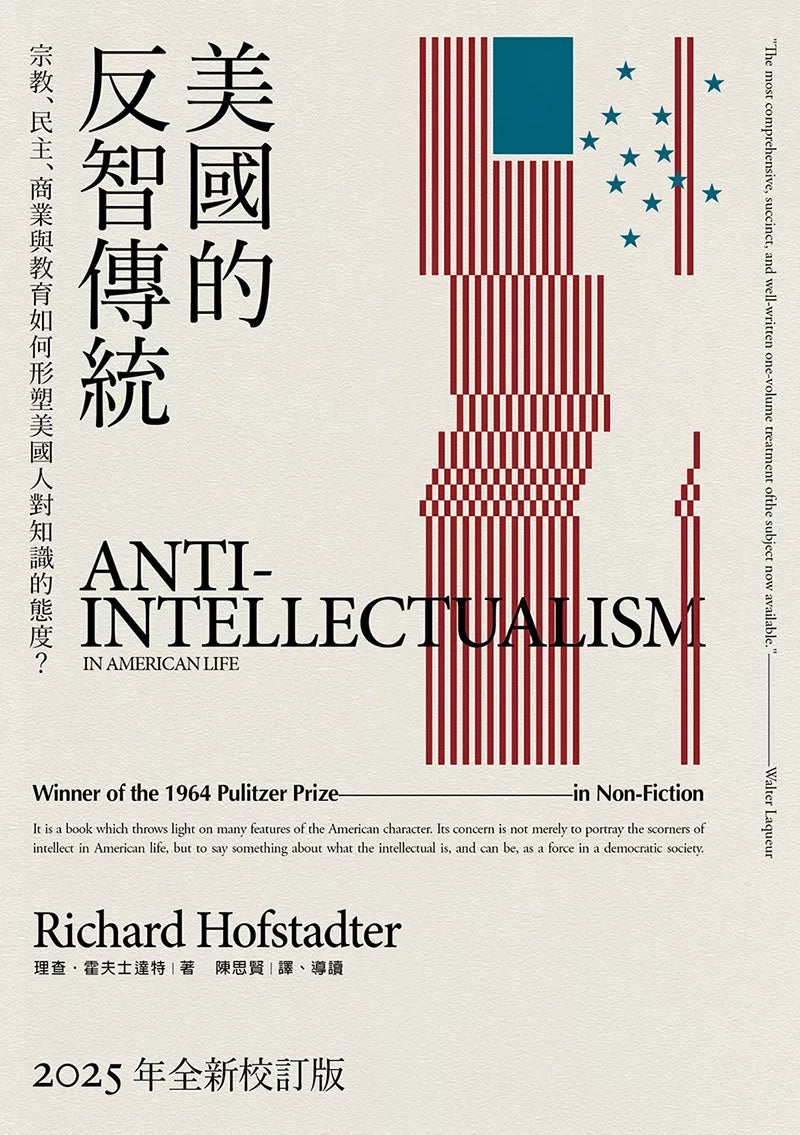
Anti-Intellectualism in American Life
Why does history keep repeating itself? Why has conservative populism risen again?"Anti-intellectualism" is part of America's deep-rooted culture and historical tradition.
Trump's "anti-intellectual" undercurrent has always been etched in the bones of Americans.
★New Revised Edition 2025★
★The most classic work by two-time Pulitzer Prize winner Richard Hofstadter★
Jointly recommended by renowned scholars such as Yu Ying-shih, Yuan Ju-cheng, Wang Fan-sen, Yen Chen-shen, and Yang Chao.
Academician Yu Ying-shih: "This is a masterpiece that will be passed down in the history of American historiography... It is a must-read for anyone who wants to understand America today."
Professor Chen Szu-hsien: "The content of this book not only deeply attracted me but also answered some questions that had accumulated in my mind during my life in America. I truly had an 'aha!' moment."
Hofstadter, active in the mid-20th century, was one of the few scholars who first noticed the phenomenon of "anti-intellectualism" in American culture. As a professor of American history at Columbia University, he deeply felt Americans' disregard and hostility towards pure scholarship, such as deep humanistic cultivation and abstract rational thought. In 1963, he published "Anti-intellectualism in American Life," a book combining intellectual history, social history, and political history. In it, he severely criticized the anti-intellectual thinking of populists, conservatives, and the far-right, while also providing a systematic and historically deep examination of anti-intellectualism. This book argues that anti-intellectualism is not just a temporary populist phenomenon, nor is it necessarily irrational impulsiveness; it reflects a tradition formed by Americans in their unique historical and cultural background. For example:
◆The experience of breaking away from Britain to establish an independent nation often led Americans to view history as a symbol of backwardness, corruption, and the exploitation of common people by feudal aristocrats.
◆Christian evangelical denominations advocated for followers' heartfelt inspiration and direct communication with God, rejecting theological discussions and contemplation.
◆The Founding Fathers' insistence on equality quickly shifted American politics towards a focus on common people who were simple, diligent, down-to-earth, and lacked higher education, marginalizing intellectuals and the gentry.
◆The booming commercial culture further directed America's education system towards practical purposes, underestimating liberal arts and humanities education.
Thus, we see that Jefferson, who drafted the Declaration of Independence, was criticized as unfit to be president because he was too learned; Theodore Roosevelt won voters' favor through his hunting skills; industrialist Andrew Carnegie criticized university education as fatally damaging to business; Tennessee had a congressman who boasted about not being able to write his own name, and Michigan paid teachers less than janitors—these are some of the incredible phenomena.
Upon its publication in 1963, this book caused a sensation, winning the Pulitzer Prize for General Nonfiction, the Emerson Award, and the Sidney Hillman Prize. Beyond the United States, the book also sparked a wide response. Contemporary Chinese historian Yu Ying-shih's 1975 essay "Anti-Intellectualism and Chinese Tradition" was inspired by this book. Today, with Trump's second term, readers can still discern in the author's words from sixty years ago a timeless depth of thought that can guide contemporary people, as well as the author's view on the role intellectuals should play in contemporary society.
Celebrity Recommendations
【Special Recommendations】
Yu Ying-shih | Academician, Academia Sinica
Yuan Ju-cheng | Professor, Department of Philosophy, National Taiwan University
【Special Introduction】
Chen Szu-hsien | Professor, Department of Political Science, National Taiwan University
【Joint Recommendations】
Wang Fan-sen | Academician, Academia Sinica
Yang Chao | Writer
Yen Chen-shen | Professor, Department of Political Science, National Chengchi University
Publication Date
Publication Date
2025-01-02
Publisher
Publisher
八旗文化
Imprint
Imprint
Pages
Pages
600
ISBN
ISBN
9786267509203
share