1
/
of
2
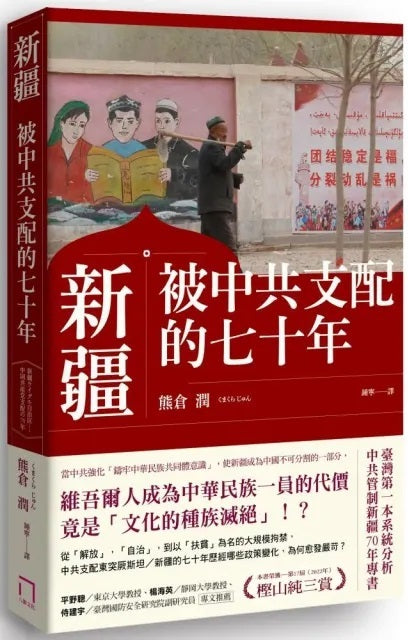
Xinjiang: Seventy Years Under Chinese Communist Party Rule
Xinjiang: Seventy Years Under Chinese Communist Party Rule
Kumakura Jun Zhong Ning 译
Regular price
$27.99 USD
Regular price
Sale price
$27.99 USD
Unit price
/
per
Low stock
Couldn't load pickup availability
About Book
About Book
Xinjiang Uyghur Autonomous Region—70 Years of Chinese Communist Party Rule
★★——Winner of the 17th (2022) Kashiyama Junzo Award——★★★★——Taiwan's first book to systematically analyze the CCP's control over Xinjiang for seventy years——★★
Satoshi Hirano / Political Historian, Yang Haiying / Cultural Anthropologist, Shih Chien-Yu / Taiwanese Defense Expert
——Specially Recommended
From "liberation" and granting "autonomy," to large-scale detention under the guise of "poverty alleviation,"
Why has the CCP's Xinjiang policy become increasingly harsh?
As the CCP strengthens the "sense of a Chinese national community" to make Xinjiang an inseparable part of China,
Is the truth behind Uyghurs becoming members of the Chinese nation actually "cultural genocide"!?
Since the establishment of the Xinjiang Uyghur Autonomous Region in 1955, the CCP declared it would "liberate ethnic minorities." However, today, the CCP has adopted severe rule, placing many people in "vocational skills education and training centers," which has drawn strong condemnation from the international community. The question is, why is the CCP doing this? What kind of governance process led to the detention of local Uyghurs and Muslims?
Initially, the CCP extensively cultivated ethnic minority cadres under the banner of autonomy, creating vested interests within the groups to prevent them from uniting and rebelling. In this regard, the CCP can be said to have maintained its rule by dividing ethnic minorities. However, since the "liberation," groups refusing to submit to the CCP have continuously resisted. In recent decades, there have also been multiple protests and riots inside and outside Xinjiang. Regarding these grievances, the CCP believed they stemmed from stagnant regional economic development, and that promoting development would gradually resolve the dissatisfaction.
But in reality, development policies widened the gap between rich and poor and also led to the deterioration of ethnic relations—especially the 2013 Tiananmen Square car attack and the Kunming railway station terrorist attack the following year, which led the authorities to conclude: to prevent impoverished ethnic minorities from becoming "extremists," monitoring must be strengthened and "anti-terrorism" policies implemented. Thus, the CCP established large training centers in Xinjiang, attempting to achieve poverty alleviation and eradicate terrorism in one fell swoop, allowing ethnic minorities to "be reborn"...
This book chronicles the CCP's rule in Xinjiang, serving as a comprehensive history of Xinjiang from "liberation" to the present under CCP rule. While tracing the historical context, it also focuses on how the status of local ethnic cadres in Xinjiang declined and how the power of Han cadres from the interior rose. It further enables readers to understand that in the seventy years since Xinjiang's "liberation," the Chinese Communist Party, once self-proclaimed as the "liberator" of ethnic minorities, has now become a political force that detains and reforms ethnic minorities.
Furthermore, the author also states that the international condemnation of the CCP's atrocities as "genocide" still requires deliberation. In reality, the plight of Uyghurs is more akin to "cultural genocide," precisely because the CCP attempts to "re-educate" Uyghurs to "be reborn" as Han people. Readers can also learn from this that the Xinjiang issue is inextricably linked to Mongolia, Tibet, Hong Kong, and Taiwan, and is the result of inherent Chinese "nationalism" at play, imposing the "sense of a Chinese national community."
Special Recommendations
Satoshi Hirano / Professor, Graduate School of Law and Politics, University of Tokyo
Yang Haiying / Professor, Faculty of Humanities and Social Sciences, Shizuoka University
Shih Chien-Yu / Associate Research Fellow, Institute for National Defense and Security Research, Taiwan
Xinjiang, Tibet, Mongolia, Hong Kong, Taiwan... The common thread running through the problems in these regions is actually the issue of tolerance for "outsiders" in Chinese civilization. The CCP labels those who are suspected of being negatively influenced by "external forces" and accuse China as "terrorists, separatists, and extremists," and strongly suppresses them. Under this mindset, not only will the "sense of a Chinese national community" absolutely not be realized, but China will also lose its flexibility towards "outsiders," thereby destroying the glorious past that once made Chinese civilization admirable.
How can such a situation be curbed to achieve the coexistence of Asia, and even various civilizations and cultures? If this book can inspire people to further consider this question, that would be a delightful outcome. ──Satoshi Hirano (Professor, Graduate School of Law and Politics, University of Tokyo)
Focusing on policy changes since the founding of the People's Republic of China. It analyzes the "anti-ethnic rightists" in the 1950s, the relationship between Uyghurs and various ethnic groups in Central Asian countries during the Sino-Soviet confrontation in the 1960s, and the subsequent series of ethnic policies such as the Cultural Revolution that led to Uyghur protests and struggles.
If the term "Uyghurs" were replaced with "Taiwan," what we would see before us is a "Party Central's policy towards Taiwan." Such CCP rhetoric not only contradicts historical facts but also can no longer resolve international relations. The history of an ethnic group cannot and should not be tampered with as "a part" of anyone else. It is very difficult for scholars to write contemporary history from an objective perspective, and Kumakura Jun's work overcomes this difficulty and is worth reading. ──Yang Haiying (Professor, Faculty of Humanities and Social Sciences, Shizuoka University)
The Chinese authorities have always been concerned about the security impact of the globalization of Islamism, and at the same time, Xi Jinping's "Belt and Road Initiative" has further highlighted the ethnic political issues in Xinjiang. From the current perspective, Xi Jinping basically retains the form of ethnic regional autonomy, but its essence has been completely abandoned, existing in name only. Xi Jinping's ethnic policy in Xinjiang is "assimilation" or ethnic transformation, shaping Turkic ethnic groups in Xinjiang into members of the Chinese nation who identify with CCP rule.
In the past few years, due to the issue of "Xinjiang re-education camps," Xinjiang's visibility in the international media has significantly increased, but the ins and outs of ethnic political development are actually difficult to understand. Therefore, for readers unfamiliar with modern Xinjiang, this book is an accessible introductory read. ──Shih Chien-Yu (Associate Research Fellow, Institute for National Defense and Security Research, Taiwan)
Publication Date
Publication Date
2023-02-01
Publisher
Publisher
八旗文化
Imprint
Imprint
Pages
Pages
272
ISBN
ISBN
9786267234235
share