1
/
of
1
The Cold War Sea
The Cold War Sea
Chen Guanren Hong Shimin 译
Regular price
$36.99 USD
Regular price
Sale price
$36.99 USD
Unit price
/
per
Low stock
Couldn't load pickup availability
About Book
About Book
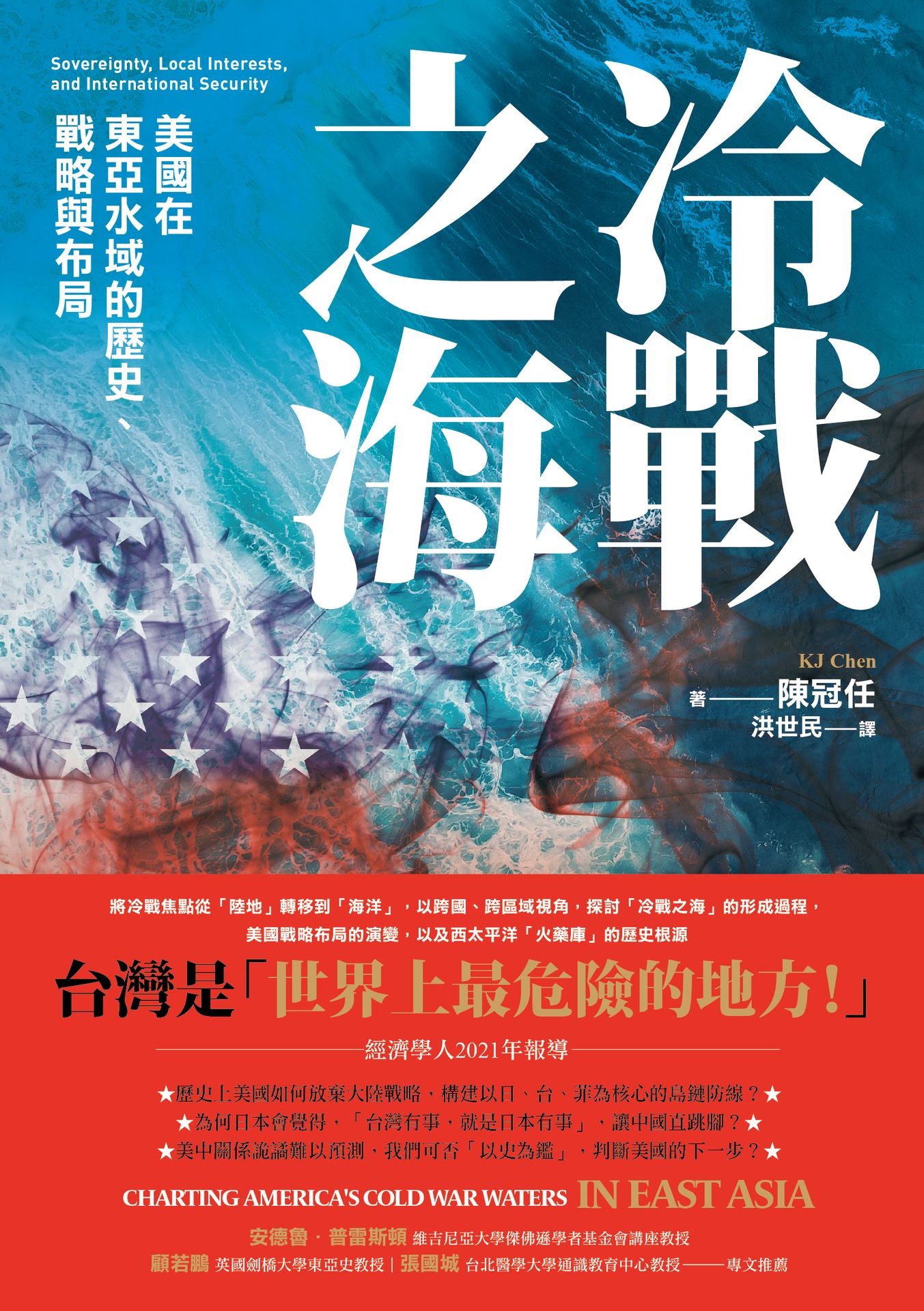
Charting America’s Cold War Waters in East Asia: Sovereignty, Local Interests, and International Security
Taiwan is "the most dangerous place on Earth!"Shifting the Cold War's focus from "land" to "sea," and adopting a transnational, cross-regional perspective,
This book explores the formation of the "Cold War Sea" and the historical roots of the "powder keg" in the West Pacific.
◆ How did the U.S. historically abandon its continental strategy and construct an island chain defense centered on Japan, Taiwan, and the Philippines?
▲ Why does Japan feel that "a Taiwan contingency is a Japan contingency," causing China to react furiously?
■ Given the unpredictable and enigmatic U.S.-China relationship, can we "learn from history" to predict America's next move?
★ Special Recommendation
Andrew Preston (J.S.M. Jefferson Foundation Chair in History, University of Virginia)
Barak Kushner (Professor of East Asian History, University of Cambridge)
Chang Kuo-cheng (Professor, Center for General Education, Taipei Medical University)
★ Awards
2024 John Lyman Book Awards, North American Society for Oceanic History
2025 The 41st Masayoshi Ohira Memorial Prize, Japan
2025 Best Book Award (Finalist), Center for Presidential History, Southern Methodist University, USA
The Cold War Sea shifts the focus of the East Asian Cold War from a traditional terrestrial perspective to a maritime one, elucidating the indispensable necessity of a historical "maritime" perspective in grand strategic thinking. Although there is already a rich body of research exploring the post-war relationship between the United States and East Asia, there remains considerable room for discussion, both in international relations and historical research, regarding the interconnected issues of maritime space, national sovereignty, and geopolitics.
Dr. Chen Guan-ren, drawing on extensive archival and textual materials in Chinese, English, and Japanese, transcends previous research frameworks. He adopts a transnational and cross-regional perspective to explore the formation of the "Cold War Sea." In recent years, the deteriorating U.S.-China relationship has transformed the East Asian waters into a powder keg, making it impossible for any country in the region to remain neutral. By redrawing the context of military competition in the East Asian seas under the Cold War structure, this book traces how the evolution of various historical factors shaped today's situation in the West Pacific and analyzes the roots of controversial issues in the region.
For us in Taiwan, understanding the historical strategic considerations of our greatest ally, the United States, and comprehending the century-long struggle for power in the West Pacific waters will help us grasp our own situation and future prospects, enabling us to make the best judgments.
★ Jointly Recommended by Academics (arranged by stroke count of surnames)
Marc Gallicchio (Professor, Villanova University)
Elizabeth Ingleson (Associate Professor, London School of Economics and Political Science)
Kawashima Shin (Professor, University of Tokyo)
Pete Millwood (Assistant Professor, University of Melbourne)
Wang Hao (International Political and Economic Expert)
Shen Rong-chin (Writer)
Matsuda Yasuhiro (Professor, University of Tokyo)
Lin Cheng-yi (Research Fellow, Institute of European and American Studies, Academia Sinica)
Hsiao-ting Lin (Curator of East Asian Collection, Hoover Institution Library and Archives, Stanford University)
Aono Toshihiko (Professor, Hitotsubashi University)
Covell Meyskens (Associate Professor, U.S. Naval War College)
W. Taylor Fain (Professor, University of North Carolina Wilmington)
Jason Kelly (Associate Professor, University of Florida)
Jan Asmussen (Professor, Kiel University)
Gregg Brazinsky (Associate Professor, George Washington University)
Leander Seah (Associate Professor, Stetson University)
Hsiao Dao-chung (Head of History Department, Fu Jen Catholic University)
Sherzod Muminov (Associate Professor, University of East Anglia)
Casper Wits (Assistant Professor, Leiden University)
Su Sheng-hsiung (Associate Research Fellow and Director of Archives, Institute of Modern History, Academia Sinica)
Acclaim
☆ "Guan-ren Chen's work helps us understand the history of the Cold War comprehensively, especially emphasizing how Cold War dynamics took shape in the East Asian maritime region. This book offers insightful perspectives on the intricate relationship between the United States and Cold War East Asia." — Kawashima Shin, Professor, University of Tokyo
☆ "Drawing on a vast array of archival materials from the United States, China, and Japan, Guan-ren Chen reveals how the U.S. established its maritime power in East Asia after World War II, and in doing so, forged connections that continue to profoundly influence the regional landscape today." — Elizabeth Ingleson, Associate Professor, London School of Economics and Political Science
☆ "We now take it for granted that the United States has interests across the entire Pacific. But Guan-ren Chen's work reminds us that America's expanded focus on the Western Pacific actually stemmed from Cold War policy needs, particularly the rise of communist China and the decline of Japan's role in the Pacific. Using English, Chinese, and Japanese sources, this book demonstrates how maritime law, resource zones, and emerging ocean governance made maritime space central to American power; at the same time, the flexible approach the United States maintained with its regional partners contributed to a lasting and regionally supported maritime order." — Pete Millwood, Assistant Professor, University of Melbourne
☆ "Guan-ren Chen's outstanding work opens a new perspective on the history of the Cold War in East Asia. This is an ambitious work that boldly confronts grand historical questions. Chen Guan-ren should be praised for his engaging, original, and insightful research." — Hsiao-ting Lin, Curator of East Asian Collection, Hoover Institution Library and Archives, Stanford University
☆ "This is a crucial work on an important but under-researched aspect of the Cold War—U.S. maritime policy in East Asia. Based on archival materials in English, Chinese, and Japanese, Guan-ren Chen meticulously explores how the United States developed its maritime strategy in East Asia and deployed military forces to contain the Soviet Union and China. Beyond the military sphere, this book also analyzes the U.S. position in the United Nations Conventions on the Law of the Sea and negotiations between the U.S. and its East Asian allies on issues such as sovereignty over fishery resources and continental shelf oil. This is a must-read for anyone wishing to understand the historical and institutional background of contemporary issues in the Indo-Pacific region." — Aono Toshihiko, Professor, Hitotsubashi University
☆ "The Cold War Sea is an excellent book, indispensable for anyone seeking to understand how the United States gradually came to view the Western Pacific as the fulcrum of its dominance in Asia." — Covell Meyskens, Associate Professor, U.S. Naval War College, The Journal of Cold War Studies
☆ "An engaging and significant study of the role of U.S. naval strategy and naval diplomacy in a critical theater of international relations." — W. Taylor Fain, Professor, University of North Carolina Wilmington, Diplomatic History
☆ "Guan-ren Chen has written a deeply researched, original, and compelling history of the American struggle to develop a strategy for controlling the maritime areas of Asia during the Cold War. His discussion of the complexities created by inter-local competition over natural resources and territorial waters is particularly helpful in understanding the multifaceted nature of the Asian Cold War." — Marc Gallicchio, Professor, Villanova University
☆ "Through multi-national, multi-lingual research approaches, Guan-ren Chen demonstrates that even though the book's title emphasizes the United States, dominance in the Cold War seas of East Asia never solely belonged to the U.S." — Jason M. Kelly, Associate Professor, University of Florida, The Journal of Asian Studies
☆ "Guan-ren Chen successfully completed a fluidly written and highly academic work that fills an important research gap, particularly in exploring the reshaping of U.S. East Asian naval strategy after Japan's defeat in 1945." — Jan Asmussen, Professor, Kiel University, Asian Studies Review
☆ "In this stunning work, Guan-ren Chen thoroughly reshapes our understanding of U.S. Cold War national security policy in the Asia-Pacific. Through meticulous and insightful analysis of U.S., Japanese, and Taiwanese archives, he clearly demonstrates the critical role of maritime Asia in U.S. strategy." — Gregg Brazinsky, Associate Professor, George Washington University
☆ "This is a groundbreaking monograph that makes extensive use of primary sources and contributes to multiple academic fields." — Leander Seah, Associate Professor, Stetson University, The Journal of Military History
☆ "After World War II, the collapse of the Japanese Empire created a power vacuum in the East Asian seas. How these waters transformed from Japan's 'inner lake' into a theater of conflict and competition dominated by the United States, a superpower in the emerging Cold War, is a process that is both important and enlightening. However, no research in any language has yet fully narrated this history from a transnational perspective. This book is an innovative study, based on archival materials in three languages, aiming to fill academic and understanding gaps, connecting complex and diverse original archives and personal data. By shifting the perspective from land to sea, Guan-ren Chen skillfully reveals how the Western Pacific gradually evolved from the periphery of the American empire to a central stage during the Cold War." — Sherzod Muminov, Associate Professor, University of East Anglia
☆ "In The Cold War Sea, Guan-ren Chen offers fresh and profound insights into U.S. maritime policy in East Asia after the dissolution of the Japanese Empire in 1945. This thoroughly researched yet accessible work clearly presents the motivations and strategies of the United States in establishing its dominance in the East Asian waters during the Cold War. The renewed regional tensions today further highlight the importance and urgency of deeply understanding the historical development of the Western Pacific maritime space. Based on extensive archival research and presented in a clear manner, this book is not only beneficial for senior scholars of East Asian studies but also provides a comprehensive picture of a hitherto insufficiently told history of the East Asian Cold War for a broader readership." — Casper Wits, Assistant Professor, Leiden University
☆ "This book demonstrates the ambition to address diverse issues, attempting to connect the intricate historical context of post-war East Asia using the 'ocean' as its setting. Its content spans multiple fields, including military deployment, diplomatic maneuvering, international maritime law disputes, and competition over fisheries and oil resources, offering a unique perspective and historical reference for understanding East Asian geopolitics." — Su Sheng-hsiung, Associate Research Fellow and Director of Archives, Institute of Modern History, Academia Sinica
Publication Date
Publication Date
2026-01-01
Publisher
Publisher
八旗
Imprint
Imprint
Pages
Pages
400
ISBN
ISBN
9786267509982
share