

1
/
of
2
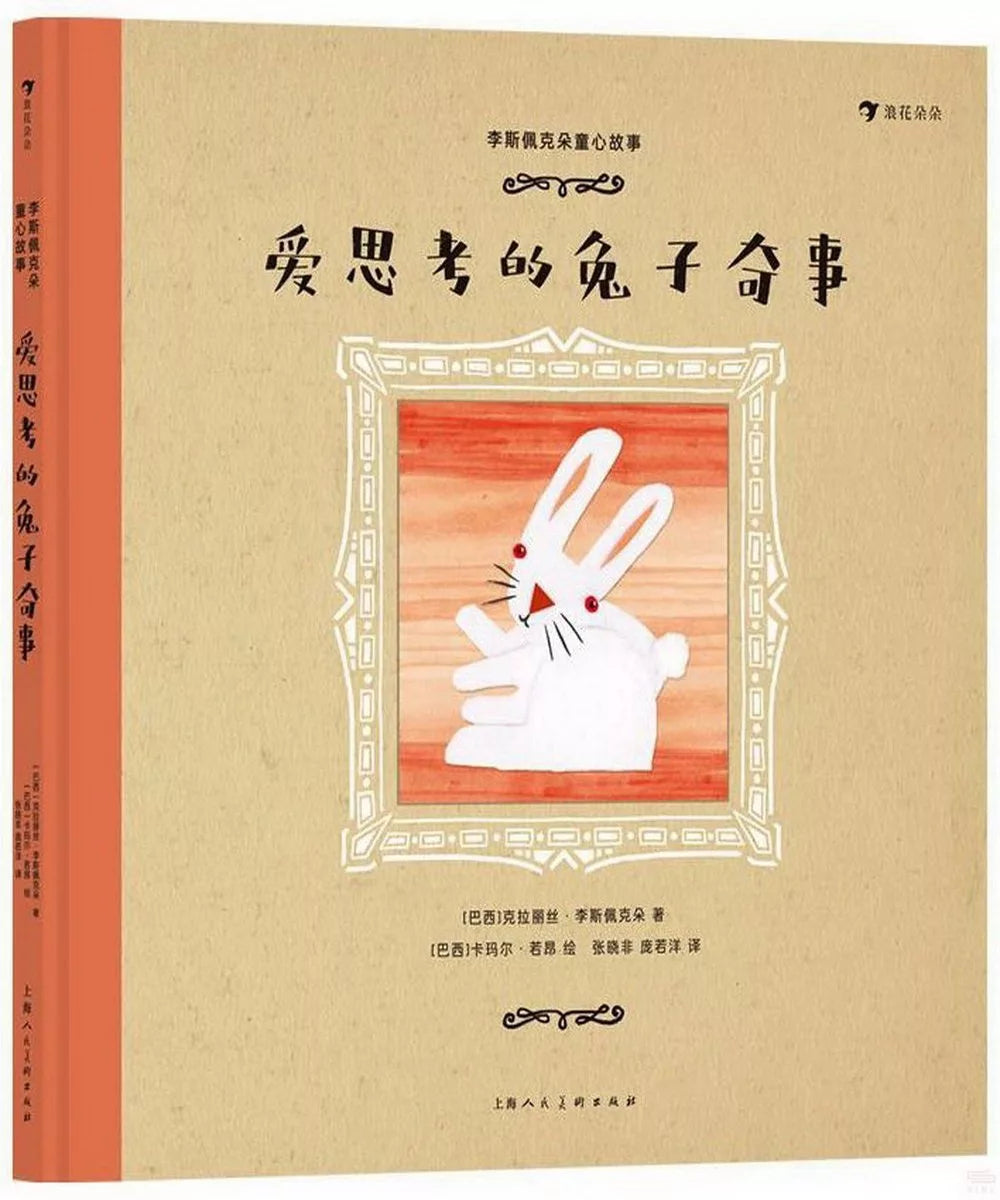
Lispector's Childhood Stories: The Amazing Feats of the Thinking Rabbit
Lispector's Childhood Stories: The Amazing Feats of the Thinking Rabbit
[Brazil] Clarice Lispector , [Brazil] Kamal João , [Brazil] Clarice Lispector Zhang Xiaofei and Pang Ruoyang 译
Regular price
$25.99 USD
Regular price
Sale price
$25.99 USD
Unit price
/
per
Out of stock
Couldn't load pickup availability
ISBN
ISBN
9787558624346
share

书籍简介
Brazilian legendary female writer Clarice Lispector's wonderful story for her son
The runaway bunny is like a child whose nature doesn't want to be restrained
Please give them freedom and tolerance
◎ Editor's Recommendation
Hailed as "the most important Jewish writer since Kafka" and one of the most important Brazilian writers of the 20th century
Clarice Lispector, a beautiful and outstanding female writer
Writes the "Lispector's Childlike Heart Stories" series for children with a mother's love
5 children's literature works, first published in Chinese
This is a mystery that has yet to be solved
Joaozinho was just an extremely ordinary rabbit
How could it be so smart to escape from that flawless cage at any time?
It comes up with fresh ideas with hundreds of nose wiggles
As for what kind of ideas, we don't know
Maybe this mystery doesn't need to be solved, just let it be
☆ Literary nourishment for children from a top writer, with a friendly and lively colloquial narrative style, full of interactive fun.
Told from a first-person perspective, in a mother's voice, it's as intimate as an evening chat around a fire, full of interaction. In the process of telling the story, Lispector, as a mother, always considers the child's emotions, responds to the child's specific questions, and tries to be close to the child's thinking and imagination, also allowing the child as a listener to experience the joy of participation.
☆ The rabbit's escape alludes to children who are unwilling to be restrained, inspiring readers to re-examine the relationship between children and parents.
It talks about the rabbit's "wiggling nose" as a sensory, instinctive way of understanding and thinking about the world with a humorous and playful tone. Although this method is primitive, it is also very effective, leading the rabbit from simply seeking food satisfaction to a broader imaginative space. This is similar to children's way of thinking, which often puzzles adults. The author implies to parents that there is no need (and it's impossible) to fully understand what children think, but to learn to give them freedom and tolerate their individuality.
☆ Unconventional geometric illustrations give the story more room for interpretation, with hidden depths in simplicity.
Geometric shapes give the picture more expansive room for interpretation; seemingly simple, they are actually multi-dimensional. The red triangle is the rabbit's constantly wiggling little nose, and it appears as an important element on most pages. It seems to have become a symbol of thought, running through the entire story.
☆ Special lenticular cover, spacious square format, exquisitely retro binding, giving children a precious literary gift.
This book is one of the "Lispector's Childlike Heart Stories" series. The entire series uses specially designed lenticular covers, full of dynamic beauty, enhancing the fun and design of the book's binding.
The cover paper is white kraft paper, with an elegant hue and frosted texture, exuding an elegant and retro literary atmosphere.
12k spacious square hardcover edition, with 140g offset paper for the interior, thick and resilient; full-color printing, restoring various styles of illustrations.
☆ Includes a professional guide, written by Zhang Xiaofei, a senior Portuguese translator and associate professor, to help readers interpret the work in depth.
◎ Synopsis
"The Thinking Rabbit's Tale" tells the story of a rabbit that mysteriously escapes from its cage. This little rabbit, named "Joaozinho," has more feelings than people imagine. It wiggles its nose quickly, and ideas pop up, making it a thinking little rabbit. It always finds a way to escape from its cage. But why it always wants to escape and how it escapes remains a mystery to its owner!
Isn't a rabbit kept in a cage a child? The story explores the relationship between children and parents, and how children find themselves, amidst reality and illusion. Young readers will see themselves in it, and parents may realize that there's no need and no way to fully understand what their children think, but to learn to give them freedom and tolerate their individuality.
◎ Media Reviews
(Lispector) was touted as "the greatest female writer in Portuguese" from the beginning of her career, and her half-century of writing practice has indeed earned her extreme accolades such as "the greatest Jewish writer since Kafka" and "the Joyce of Brazil"...
——Min Xuefei (Translator of Lispector's works)
Clarice Lispector's children's works are innovative because they can deal with children's issues in a non-childish way, with the understanding of the child as the constant underlying tone.
——Rosa Gens (Doctor of Literature, Federal University of Rio de Janeiro)
"The Thinking Rabbit's Tale" is an excellent children's book that allows children to start encountering outstanding writers at a young age, stimulating their interest in reading and curiosity about great authors. Furthermore, this book is a delightful read for adults as well.
——Amazon Reader Review
Like all of Clarice's works, this book surprised me too! Beautiful words expressed in an innocent and lovely way.
——Amazon Reader Review
◎ Celebrity Recommendations
One of the most mysterious writers of the twentieth century, her writing is full of vivid colors.
—— Orhan Pamuk (Nobel Prize in Literature laureate)
◎ Awards
"The Thinking Rabbit's Tale" won the Kalunga Award.
出版日期/Publication Date:
出版社/Publisher:上海人民美术出版社
出品方/Imprint:the new wave
页数/Page: 48