
1
/
of
1
Sunset Radiance
Sunset Radiance
Wei Qingyuan
Regular price
$70.99 USD
Regular price
Sale price
$70.99 USD
Unit price
/
per
Low stock
Couldn't load pickup availability
ISBN
ISBN
9787203128830
share
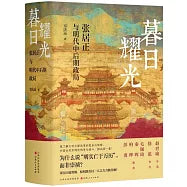
书籍简介
◉New introduction by Zhao Shiyu and preface by Xu Hong
◉A milestone work in Zhang Juzheng studies
◉The most in-depth, fair, and truly "neither concealing good nor evil, but adhering to facts" magnum opus written about Zhang Juzheng
◉A representative work by Mr. Wei Qingyuan, a veteran and renowned scholar in Ming and Qing history
◉Recommended by Mao Peiqi, Qin Hui, Bai Hua, and Peng Yong
Celebrity Recommendations:
This book can be said to be the most in-depth, fair, and truly "neither concealing good nor evil, but adhering to facts" magnum opus since biographies of Zhang Juzheng began to be written.
——Xu Hong, Professor, Department of History, National Taiwan University
This book starts from the specific content of Zhang Juzheng's policies, analyzes their pros and cons, traces their origins and causes, and provides a comprehensive evaluation from a holistic perspective. From the discussion throughout the book, the author basically affirms Zhang Juzheng's actions during his "reign." In addition, the book offers its own views on issues of character such as the relationship between Zhang Juzheng and the eunuch Feng Bao, and whether Zhang Juzheng himself was corrupt. Generally speaking, it adheres to the principle of neither concealing evil nor overpraising good. It can be said that, from all these aspects, this book is a systematic response to some major issues in previous Zhang Juzheng studies.
——Zhao Shiyu, Professor, Department of History, Peking University
The characteristic of this book is not a scattered, flat narrative, but rather a macro-level contemplation; it is not a personal history of Zhang Juzheng, but rather the entire political situation of the mid-to-late Ming Dynasty – the operation of the court, the implementation of official administration, even overt and covert schemes, and social activities.
——Mao Peiqi, Professor, Renmin University of China
Editor's Recommendation:
If you want to understand the complexity and difficulty of reforms in the Great Ming Dynasty, and the open and secret struggles in ancient Chinese officialdom, this is a must-read!
With the edifice on the verge of collapse, how did the powerful prime minister Zhang Juzheng single-handedly turn the tide?
Why is it said that "the Ming Dynasty truly perished in the Wanli reign," rather than Chongzhen?
Reform inevitably leads to major restructuring of society, economy, and politics. How to break the original balance of power and interests and advance reforms deeply?
How to escape the historical vicious cycle of "the policy dies with the person"?
Which should you choose: an honest but mediocre official, or a corrupt but capable one?
Does the rise in power inevitably lead to a decline in rationality?
Summary:
This book can be said to be the most in-depth, fair, and truly "neither concealing good nor evil, but adhering to facts" magnum opus since biographies of Zhang Juzheng began to be written. (According to Taiwanese scholar Xu Hong)
Its greatest difference from previous works lies in the author's use of a large amount of rare and rich historical materials. In addition to official publications such as "Veritable Records" and administrative books, it cites over 150 kinds of private notes, collected works, and letters, and 65 kinds of local gazetteers, mainly from the Ming Dynasty. This allows for in-depth exploration of many details that previous scholars have not discussed.
Regarding the intricate interpersonal relationships Zhang Juzheng had to face during the reforms, the author categorizes them separately, including the emperor and empress dowager above, as well as powerful eunuchs, imperial relatives, and various remonstrating officials. Especially, the grand secretaries of the cabinet and important civil officials who served with Zhang Juzheng are all mentioned. The number of people involved and the detailed research are rarely seen in similar works.
At the same time, the book proposes a new judgment and concept of "Longqing-Wanli Reform." Upon re-examination, it was found that Gao Gong and Zhang Juzheng had already jointly carried out major reforms during the Longqing period, achieving significant accomplishments in personnel administration, economy, and military affairs, bringing hope of revival to the dying Ming Dynasty. It can be said that the reforms carried out by Zhang Juzheng in the early Wanli reign were a continuation of the Longqing reforms. This achievement is undoubtedly a new breakthrough and contribution to the study of Ming Dynasty history in the mid-to-late period.
It is particularly worth noting that the book provides a dynamic narrative of Zhang Juzheng's leadership in the reform process. It not only describes how Zhang Juzheng strategized, selected capable people, and deployed resources properly, but also portrays the reality of how he firmly commanded and boosted morale amidst the conflicts between reform and anti-reform. While fully affirming Zhang Juzheng's great historical role, it also truthfully records his "mistakes, indiscretions, and moral failings."
To implement reforms, Zhang Juzheng had to centralize power. However, when power is concentrated in one person without checks, it is bound to invite backlash from imperial authority, leading to tragedy. The tragic fate of Zhang Juzheng after his death perfectly illustrates this point. Under a system of personal autocracy, this was an inevitable outcome.
出版日期/Publication Date:
出版社/Publisher:山西人民出版社
出品方/Imprint:Han Tang Sunshine
页数/Page: 872